By Larson Health | LarsonNutrition.com
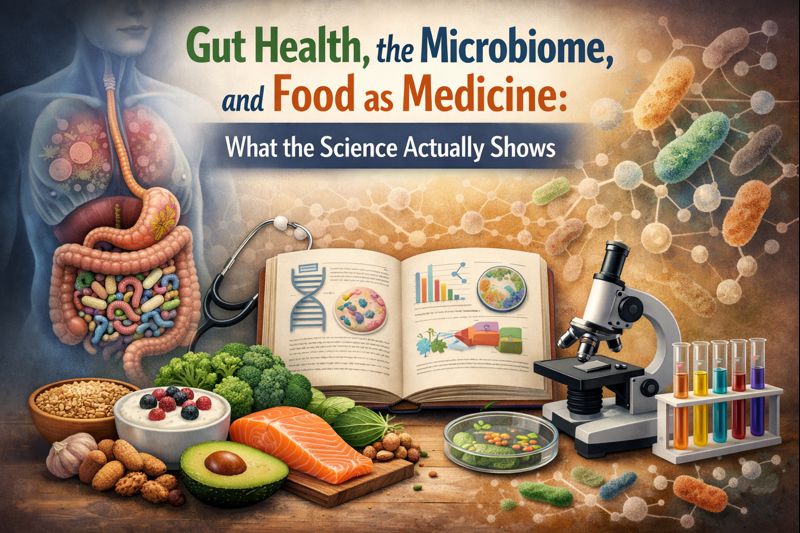
Gut health has become one of the most talked-about topics in wellness — and for good reason. Research from institutions like the Global Wellness Institute, FranHealth, and leading nutrition science organizations shows that the health of your gut microbiome affects everything from digestion and inflammation to immunity, mood, and metabolic health.
But with so many gut powders, probiotic drinks, and “quick fixes” on the market, people often ask: what’s actually real, and what’s just hype?
This article breaks down the science in clear, simple terms — and explains how you can use food as medicine to support gut repair, balance your microbiome, and improve your overall health, even on a budget.
Your gut microbiome is a community of trillions of bacteria and microbes living mostly in your large intestine. Scientists often describe it as an internal ecosystem. A healthy gut isn’t dominated by one “super bacteria” — it’s diverse, balanced, and functioning like a rainforest with many species doing different jobs.
Research shows that this microbial community influences digestion, inflammation, hormone balance, immune function, and even neurotransmitter production.
A review from the Institute of Food Technologists (IFT) explained how the types of fiber we eat directly impact which microbes thrive — and what compounds they produce. Study: https://www.ift.org/policy-and-advocacy/advocacy-toolkits/microbiota
Fermentable fibers, in particular, get broken down into short-chain fatty acids like butyrate — molecules that strengthen the gut lining, reduce inflammation, and support the immune system.
Online, the term “leaky gut” gets misused a lot. In scientific literature, the condition is called increased intestinal permeability, and it is very real.
Your gut lining is only one cell thick. When stressed — by infections, medications, alcohol, processed foods, or chronic inflammation — those cells can become more permeable, allowing unwanted particles to enter the bloodstream.
Two well-known nutrients studied for their impact on gut permeability include:
Glutamine
A meta-analysis found that glutamine supplementation improved gut barrier integrity in adults.
Study: https://pubmed.ncbi.nlm.nih.gov/34829236/
Zinc Carnosine
A clinical trial showed zinc carnosine reduced NSAID-induced increases in gut permeability.
Study: https://pubmed.ncbi.nlm.nih.gov/10425102/
These findings don’t mean supplements replace nutrition — but they validate that gut repair has biochemical foundations, not just wellness marketing.
The Global Wellness Institute’s Nutrition for Healthspan Initiative highlights a major shift toward nutrient-dense foods, regenerative agriculture, and personalized diets as tools for longevity.
Report: https://globalwellnessinstitute.org/global-wellness-institute-blog/2025/04/02/nutrition-for-healthspan-initiative-trends-for-2025/
Why? Because the foods we eat have a direct impact on our microbiome.
A 2025 review showed that plant-rich diets — especially Mediterranean-style eating — increase beneficial bacteria and decrease inflammation.
Study: https://pubmed.ncbi.nlm.nih.gov/39365665/
Ultra-processed foods do the opposite. A major review in Nutrients linked high processed food intake to lower microbial diversity, more gut inflammation, and higher disease risk.
Study: https://pubmed.ncbi.nlm.nih.gov/38361274/
In simple terms:
Whole foods build a resilient gut.
Ultra-processed foods degrade it.
You don’t need expensive superfoods or supplements to build a healthier gut. Some of the strongest microbiome-supportive foods are inexpensive pantry staples.
Fiber-Rich Foods
Oats, beans, lentils, vegetables, berries, apples, chia seeds
Fermented Foods
Plain yogurt with live cultures, kefir, sauerkraut, kimchi, miso
Polyphenol-Rich Foods
Olive oil, berries, herbs, green tea, onions, garlic
A recent consumer-facing summary echoed this, emphasizing fiber, fermented foods, and plant diversity as the top dietary strategies for gut health.
Source: https://www.eatright.org/health/digestive-health/digestive-disorders/top-foods-for-gut-health
Together, these foods feed beneficial microbes, help repair the gut lining, and lower inflammation.
A 2024 meta-analysis showed that regular aerobic exercise significantly increases microbial diversity — particularly species that produce anti-inflammatory short-chain fatty acids.
Study: https://pubmed.ncbi.nlm.nih.gov/39618183/
Even walking, cycling, or strength training shifts the microbial ecosystem in positive ways.
Movement isn’t just good for weight or fitness. It literally reshapes the internal environment of your gut.
The gut and brain communicate constantly through the vagus nerve, a major pathway of the parasympathetic nervous system.
A 2024 review in Neuroscience & Biobehavioral Reviews found that gut microbes affect brain function through neural, immune, and hormonal pathways — especially the vagus nerve.
Study: https://pubmed.ncbi.nlm.nih.gov/38782653/
This explains why gut imbalances often show up as:
Improving gut health — and supporting vagal tone through slow breathing, humming, or meditation — can help calm the nervous system.
Large population studies show strong links between ultra-processed foods and higher risks of:
One of the largest studies analyzing ultra-processed food consumption and mortality found significantly higher death rates among high consumers.
Study: https://pubmed.ncbi.nlm.nih.gov/31221882/
On the flip side, the landmark DiRECT trial demonstrated that nutrition interventions alone put nearly half of participants’ type 2 diabetes into remission at one year.
Study: https://pubmed.ncbi.nlm.nih.gov/29221645/
Food can be a powerful tool for reversing disease patterns — not just preventing them.
You do not need a fancy grocery store or expensive supplements to improve your microbiome.
Affordable staples like oats, beans, lentils, frozen vegetables, brown rice, bananas, carrots, potatoes, onions, cabbage, canned salmon, and plain yogurt can build a gut-healing foundation.
A microbiome-friendly day on a budget could look like:
Small changes done consistently shift the microbiome — and your health — in profound ways.
Gut health is not a trend — it’s foundational biology.
Yes, the wellness industry can exaggerate. But high-quality research continues to show that:
You don’t need perfection. You need patterns. More whole foods, more plants, more fiber, more fermented foods, more movement, more calm — and fewer ultra-processed, additive-heavy products.
If you want personalized support for gut healing or nutrition for your stage of life, visit LarsonNutrition.com to learn more, or get personalized coaching to be 80% more successful. If you want all organic ingredient skin care and candles to support hormones, visit LarsonBotanicals.com