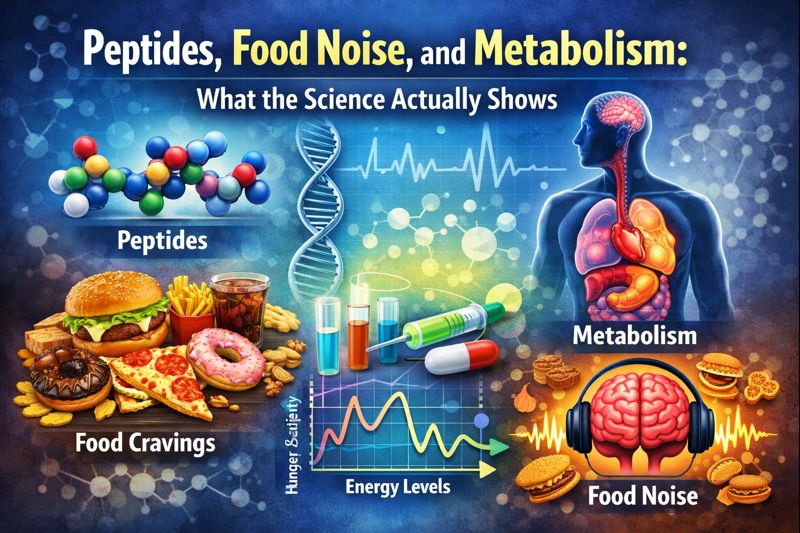
Peptides have emerged as one of the most widely discussed tools in metabolic health, weight regulation, and longevity medicine, yet they are frequently presented as a single intervention rather than a biologically diverse class of signaling molecules. This lack of distinction has created unnecessary confusion, inflated expectations, and misplaced skepticism. Peptides are neither a miracle solution nor an unsubstantiated trend. They are fundamental components of human physiology whose relevance depends entirely on context, delivery, and evidence quality.
A scientific discussion of peptides requires separating pharmaceutical peptide drugs, unregulated injectable wellness peptides, and food-derived bioactive peptides. Each category operates under different biological mechanisms, regulatory standards, and levels of human evidence. When these distinctions are ignored, peptide science becomes vulnerable to overstatement rather than understanding.
Peptides are short chains of amino acids that act primarily as signaling molecules rather than structural proteins. Their role is to transmit information between cells, tissues, and organ systems, coordinating responses related to glucose regulation, appetite, inflammation, immune activity, and tissue repair. This signaling function places peptides at the center of metabolic regulation.
Many of the most critical hormones involved in energy balance are peptides. Insulin and glucagon regulate glucose storage and release. Gut-derived peptide hormones such as GLP-1, peptide YY, and cholecystokinin influence satiety, gastric emptying, insulin secretion, and postprandial metabolism. These pathways are not speculative. They are well described in endocrine physiology and summarized in comprehensive reviews of peptide hormones and metabolic regulation
https://www.ncbi.nlm.nih.gov/pmc/articles/PMC5440312/
The modern peptide conversation is not about discovering new biology, but about selectively influencing existing signaling systems. Whether that influence is beneficial depends on the pathway targeted, the method of delivery, and the strength of the evidence supporting its use.
Peptide research spans every tier of scientific evidence, and understanding this hierarchy is essential for interpreting claims about peptide supplements, peptide drugs, and metabolic outcomes.
Mechanistic studies identify receptor binding and intracellular pathways, often using cell cultures or isolated systems. These studies establish biological plausibility but cannot predict human outcomes. Animal studies provide insight into systemic effects and early safety signals, yet translation to human physiology remains inconsistent.
Small human trials offer preliminary data on tolerability and short-term effects but are frequently limited by sample size, duration, and population specificity. Large randomized controlled trials remain the highest standard, providing reproducible outcomes, dosing clarity, and adverse-event monitoring.
Much of the confusion surrounding peptides arises when early-stage mechanistic or animal data is marketed with the confidence of late-stage human trials. This is not unique to peptides, but the diversity of peptide categories amplifies the problem.
The strongest human evidence for peptide-based interventions exists within pharmaceutical medicine, particularly with GLP-1 receptor agonists used in the treatment of type 2 diabetes and obesity. These peptide drugs have been evaluated in multiple large randomized controlled trials demonstrating consistent improvements in hemoglobin A1C, body weight, and cardiometabolic risk markers.
GLP-1 receptor agonists exert their effects through several well-characterized mechanisms, including glucose-dependent insulin secretion, suppression of glucagon, delayed gastric emptying, and central appetite signaling modulation. These effects are documented across diverse populations and clinical settings. A detailed review of clinical outcomes and mechanisms is available through PubMed Central
https://www.ncbi.nlm.nih.gov/pmc/articles/PMC11579408/
These medications represent high-confidence evidence precisely because they are regulated, standardized, and clinically monitored. Their success does not imply that all peptides exert similar effects, nor does it justify extrapolating pharmaceutical outcomes to non-pharmaceutical peptide products.
Injectable peptides promoted in wellness, performance, and longevity communities occupy a markedly different evidentiary category. Compounds such as BPC-157, TB-500, CJC-1295, ipamorelin, and AOD-9604 are frequently discussed based on mechanistic rationale, animal data, or anecdotal reports rather than large, long-term human trials.
The absence of robust human data limits confidence regarding efficacy, dosing consistency, and long-term safety. This uncertainty is compounded by regulatory concerns. The U.S. Food and Drug Administration has published guidance identifying risks associated with certain bulk drug substances used in compounding, including immunogenicity, peptide impurities, and insufficient safety data
https://www.fda.gov/drugs/human-drug-compounding/bulk-drug-substances-used-compounding-under-section-503b-fdc-act
Injectable delivery bypasses gastrointestinal and hepatic filtration systems, increasing potential consequences of contamination or dosing error. For this reason, injectable peptide interventions warrant higher evidentiary standards, not lower ones. Claims that exceed available data do not advance peptide science and undermine public trust.
Food-derived bioactive peptides represent a distinct category rooted in nutrition research rather than pharmacology. These peptides are generated when dietary proteins are broken down through digestion, fermentation, or enzymatic hydrolysis, producing smaller fragments capable of interacting with biological systems.
A 2022 review in Nutrients summarizes evidence that bioactive peptides derived from food proteins can exert antioxidant, anti-inflammatory, immunomodulatory, and antihypertensive effects
https://www.ncbi.nlm.nih.gov/pmc/articles/PMC8836030/
Additional reviews focusing on glucose regulation and insulin sensitivity describe how protein hydrolysates and peptide fragments may influence metabolic signaling pathways relevant to diabetes and energy balance
https://www.ncbi.nlm.nih.gov/pmc/articles/PMC12249546/
This literature does not support uniform outcomes across all peptide sources or formulations. It does, however, establish biological plausibility for nutritional peptides as modulators of metabolic signaling rather than direct therapeutic agents.
A frequent criticism of peptide supplements is that oral ingestion negates biological activity. Human data does not support such a categorical dismissal. While many peptides are degraded during digestion, specific peptide fragments have been detected in circulation following ingestion.
Studies examining collagen hydrolysates demonstrate dose-dependent increases in hydroxyproline-containing peptides in human plasma
https://www.ncbi.nlm.nih.gov/pmc/articles/PMC7328867/
A separate pilot study identified cyclic Pro-Hyp peptides in human plasma after oral ingestion, supporting the conclusion that certain peptide fragments can survive digestion and reach systemic circulation
https://www.ncbi.nlm.nih.gov/pmc/articles/PMC5818104/
Beyond absorption, oral peptides exert effects through the gastrointestinal tract itself. The gut functions as a major endocrine organ, producing peptide hormones that regulate appetite, glucose handling, and energy partitioning. Interaction with gut-based signaling pathways represents a primary mechanism for many nutrition-based peptide effects.
What is often described as “food noise” reflects dysregulation across interconnected neuro-metabolic systems rather than excessive hunger alone. Appetite and craving patterns arise from interactions among gut-derived peptides, glucose variability, reward circuitry, stress hormones, and autonomic nervous system tone.
Reviews of gut–brain peptide signaling describe how nutritional input influences neural regulation of appetite and energy balance through bidirectional communication pathways
https://www.ncbi.nlm.nih.gov/pmc/articles/PMC7213601/
Protein hydrolysates and peptide fragments have been shown to influence gut hormone responses associated with satiety and postprandial metabolism
https://www.ncbi.nlm.nih.gov/pmc/articles/PMC5566666/
From a physiological standpoint, changes in perceived food noise may reflect improved signaling coherence rather than appetite suppression. Factors such as improved glucose stability, reduced stress-related eating, hydration status, and gut hormone responsiveness can converge to alter appetite perception without pharmacologic intervention.
Short-term changes in body composition frequently represent a convergence of metabolic adaptations rather than isolated fat loss. Reduced inflammation, shifts in water balance, improved recovery, better sleep quality, and improved dietary adherence all contribute to early visible changes.
Review literature examining food-derived bioactive peptides discusses their potential role as supportive tools in obesity and metabolic regulation, emphasizing modulation of signaling pathways rather than direct therapeutic effects
https://www.ncbi.nlm.nih.gov/pmc/articles/PMC7071257/
These findings support a cautious interpretation: nutritional peptides may enhance the physiological environment in which favorable metabolic adaptations occur, particularly when foundational behaviors are in place.
The distinction between supportive and therapeutic claims reflects evidence thresholds rather than marketing language. Supportive claims describe modulation of physiological processes within normal regulatory ranges, acknowledging individual variability and the influence of diet, lifestyle, and baseline metabolic health. Therapeutic claims imply disease modification, predictable clinical outcomes, and direct intervention in pathological processes, requiring drug-level evidence and regulatory oversight.
Food-derived peptides and nutraceutical formulations remain within the supportive domain because current evidence supports signaling modulation rather than disease treatment. Precision in language preserves scientific credibility. Overextension of claims does not strengthen confidence; it undermines it.
Peptides function as messengers. Their role is to support communication within biological systems, not to override foundational physiology. Metabolic health remains dependent on blood sugar regulation, adequate protein and muscle mass, sleep quality, circadian alignment, nervous system regulation, micronutrient sufficiency, gut integrity, and movement.
Nutritional peptides may support these systems, improve signaling efficiency, and enhance adherence by reducing friction within metabolic pathways. They do not replace the fundamentals upon which metabolic resilience is built.
Scientific progress advances through careful interpretation rather than exaggerated certainty. In peptide research, credibility belongs to those who distinguish clearly between established evidence and emerging hypotheses.
For further work grounded in metabolic physiology and evidence-based nutrition, visit larsonnutrition.com.