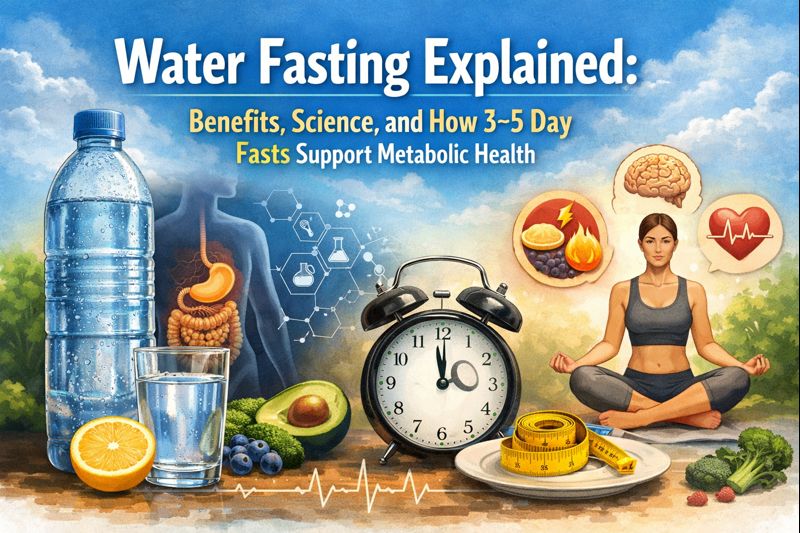
Water fasting has deep roots in human history and modern science. Learn how 3–5 day water fasts support metabolic health, insulin sensitivity, inflammation, and healing—plus how to fast safely and effectively.
Water fasting is often portrayed as extreme or experimental, but when viewed through the lens of human biology and history, it is anything but new. Long before modern nutrition advice, humans lived in cycles of eating and not eating. Food availability depended on seasons, weather, migration, and hunting success. As a result, the human body evolved metabolic systems specifically designed to function during periods without food.
This evolutionary reality matters, because it explains why fasting is not inherently stressful to the body. Instead, fasting activates deeply conserved pathways that allow humans to switch fuel sources, preserve energy, and maintain function even in the absence of regular meals.
Modern research does not invent fasting biology — it confirms it.
At the core of fasting’s benefits is metabolic flexibility. This refers to the body’s ability to transition smoothly between using glucose for fuel when food is available and using stored fat and ketones when food intake pauses.
In metabolically healthy individuals, this switch happens gradually and efficiently. Blood sugar remains stable, energy is available, and hunger does not escalate endlessly. In contrast, many modern adults have impaired metabolic flexibility due to constant eating, frequent insulin spikes, and minimal time spent in a fasted state.
Water fasting creates a physiological window where insulin levels fall, stored energy becomes accessible, and metabolic pathways that are rarely used in modern life are reactivated.
Research consistently shows that fasting improves insulin sensitivity — often even when calorie intake does not change dramatically. This highlights a key point: fasting works not simply because people eat less, but because insulin signaling is given time to reset.
For most of human history, eating three meals per day with snacks in between did not exist. Humans ate when food was available and adapted when it was not. During periods of fasting, the body followed a predictable sequence.
First, it used circulating glucose. Then it released glycogen stored in the liver to maintain blood sugar. As glycogen declined, insulin levels fell, allowing fat to be broken down and ketones to be produced. These ketones became a primary fuel source for the brain and muscles.
This process occurred automatically and efficiently because it had to. Humans still needed to think clearly, travel long distances, and respond to their environment during food scarcity. Fasting did not impair function — it preserved it.
This same metabolic progression is what modern humans experience during water fasting today.
Fasting is not only biological — it is cultural. Nearly every major religion incorporates fasting practices, despite emerging independently across different regions of the world.
Judaism used fasting as a period of reflection and realignment. Christianity emphasized fasting as a way to quiet physical appetite and heighten discernment. Islam established Ramadan, a structured daily fasting rhythm that balances restraint with nourishment and community. Eastern traditions paired fasting with meditation and stillness.
These traditions were not based on laboratory data, yet they all recognized the same outcome: when digestion quiets, clarity increases.
Modern physiology helps explain why. When food intake pauses, blood flow shifts away from the gut, inflammatory signaling often decreases, and the nervous system moves toward a more restorative state. Ketones provide a steady fuel source for the brain, reducing fluctuations in energy and mood.
Large-scale studies of religious fasting, particularly Ramadan, consistently show improvements in insulin sensitivity, lipid metabolism, inflammatory markers, and mental well-being — often without major calorie reduction. Rhythm, not deprivation, appears to be the key.
During the first 24 hours of a water fast, the body relies on stored glycogen to maintain blood sugar. Hunger during this phase is often driven by habit and hormonal timing rather than true energy deficiency.
Between 24 and 36 hours, glycogen stores become depleted and the body increases fat oxidation and ketone production. Hunger typically changes character during this phase, becoming quieter and less urgent as internal fuel becomes available.
From 36 to 48 hours, ketones rise further and become a dominant fuel source, particularly for the brain. Many people report mental clarity, calm focus, and reduced food noise during this period.
By 48 to 72 hours, the body is fully adapted to fasting metabolism. Fat and ketones supply most energy needs, insulin remains low, and digestion is completely at rest. Research conducted in clinical fasting settings shows stable ketone levels, reduced inflammatory signaling, and improved metabolic markers during this phase.
Five-day water fasts, studied in controlled environments, extend these effects further. Fat oxidation remains high, insulin sensitivity stays improved, and inflammatory pathways continue to quiet. These longer fasts require careful attention to hydration, mineral balance, and rest, but they demonstrate the body’s remarkable capacity for adaptation.
Muscle preservation is one of the most common concerns surrounding fasting. Research shows that while some lean mass loss can occur during prolonged fasting, much of this loss is related to water and glycogen rather than contractile muscle tissue.
As ketone levels rise, the body relies less on breaking down muscle protein for glucose production. Ketones have a muscle-sparing effect, particularly when fasting is followed by proper refeeding and resistance-based movement.
Muscle health depends on the full cycle: fasting, nourishment, protein intake, and mechanical loading. When fasting is used cyclically rather than continuously, muscle can be preserved and even strengthened over time.
Light movement such as walking supports fasting physiology by enhancing fat oxidation and circulation without increasing glucose demand. Gentle aerobic activity and mobility work are generally well tolerated during fasting.
More intense exercise is better placed in the fed state, where nutrients are available to support repair and adaptation.
Black coffee and plain tea do not significantly raise insulin and may support fat mobilization during fasting. Electrolytes do not break a fast metabolically and are essential for nerve, muscle, and cardiovascular function during longer fasts.
Small amounts of fat such as MCT oil technically end a zero-calorie fast, but they do not disrupt insulin signaling and may support ketone production. The relevance of this depends on the goal of the fast — metabolic benefit, not ideological purity.
Dry fasting refers to fasting without food or water for limited periods. While it appears in some religious traditions, scientific research on dry fasting is limited compared to water fasting.
Dry fasting increases metabolic water production through fat oxidation, but it also increases physiological stress on the kidneys and cardiovascular system. Current evidence suggests dry fasting is best reserved for short durations and specific contexts, and it is not appropriate for many individuals.
Water fasting remains the most studied and physiologically supported approach to extended fasting.
Fasting reduces metabolic input, making the body more sensitive to stressors that are otherwise tolerated. Noise, emotional stress, light exposure, and chemical load all matter more when digestion is quiet.
This is why reducing overall toxic burden supports the fasting process. Skincare, fragrances, and environmental exposures all contribute to the body’s workload.
Supporting metabolic calm extends beyond food alone.
Refeeding is not the end of fasting — it is its continuation. After prolonged fasting, digestion is quiet and insulin sensitivity is high. Gradual refeeding allows digestive enzymes, gut motility, and electrolyte balance to return smoothly.
Traditional cultures instinctively broke fasts with broths and simple foods. Modern physiology confirms this approach supports metabolic stability and reinforces the benefits gained during fasting.
Fasting is most effective when used cyclically, followed by nourishment, strength training, and recovery.
Water fasting is not about discipline or deprivation. It is about restoring a biological rhythm the human body recognizes. When used intentionally, fasting supports insulin sensitivity, metabolic flexibility, inflammation regulation, and internal balance.
The body is not fragile. It is adaptive.
Fasting works not because it forces change, but because it allows the body to do what it already knows how to do.
Fasting is one of the most elegant tools available for metabolic healing when used with education, respect, and intention. It reconnects modern humans with a rhythm that shaped our biology for thousands of years.
If you are ready to support your metabolic health through fasting, nutrition, lifestyle alignment, and non-toxic living, visit LarsonNutrition.com to learn more about programs and resources designed to help you heal from the inside out. You can find hormone supportive skin care and candles at LarsonBotanicals.com all made with certified organic ingredients.