Parkinson’s disease is now recognized as one of the fastest-growing neurological disorders in the world. In recent years, headlines have circulated claiming Parkinson’s is increasing by 50–60%, and while the exact percentage depends on how the data is analyzed, the broader trend is undeniable: Parkinson’s is rising at an alarming rate.
A major global analysis published in The BMJ (2025) estimates that the number of people living with Parkinson’s disease worldwide will more than double by 2050, increasing from approximately 12 million in 2021 to over 25 million people. Importantly, this rise is not explained by aging alone. Even after adjusting for population age, Parkinson’s prevalence is still expected to increase substantially.
This raises an important question — one functional nutrition is uniquely positioned to ask:
Why is Parkinson’s becoming more common now?
From a functional nutrition and systems-biology perspective, Parkinson’s disease is best understood not as a single-cause condition, but as a multi-factor convergence that develops over decades.
Most cases of Parkinson’s are not genetic. While certain gene mutations increase susceptibility, the majority of people diagnosed have no strong family history. This points toward environmental, metabolic, inflammatory, and lifestyle factors interacting with individual vulnerability.
Key contributors consistently discussed in the scientific literature include:
Aging increases vulnerability — but modern exposures and lifestyle patterns appear to be accelerating disease risk.
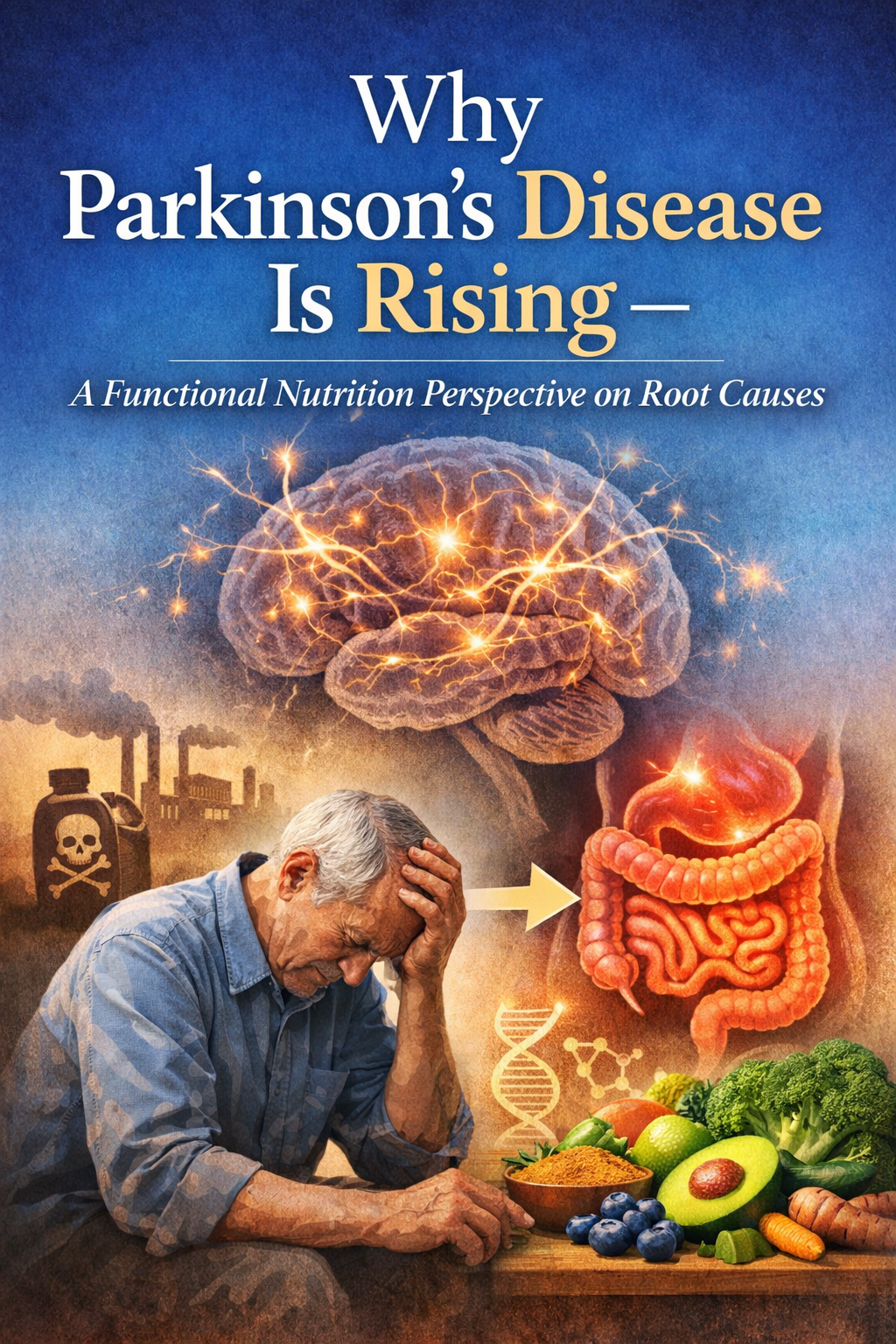
One of the most compelling explanations for the rise in Parkinson’s involves environmental chemical exposure, particularly substances that impair mitochondrial function and increase oxidative stress.
For decades, epidemiological studies have shown higher Parkinson’s rates among individuals with occupational or residential exposure to certain pesticides. Compounds such as paraquat and rotenone are frequently used in laboratory models because they reliably induce Parkinson-like neurodegeneration by damaging dopamine-producing neurons.
These chemicals interfere with mitochondrial energy production — a mechanism repeatedly implicated in Parkinson’s pathology.
Trichloroethylene is an industrial solvent historically used for metal degreasing and still present as a groundwater contaminant in some areas.
A growing body of literature — including reviews published in Environmental Health Perspectives — suggests long-term TCE exposure may increase Parkinson’s risk. In late 2024, the U.S. Environmental Protection Agency announced a ban on TCE, citing concerns over neurological toxicity.
While association does not prove causation, the biological plausibility is strong, and the precautionary principle applies.
Functional nutrition takeaway:
You cannot supplement your way out of toxic exposure — but nutrition plays a critical role in reducing total toxic burden and strengthening detoxification and antioxidant systems.
One of the most consistent biological themes in Parkinson’s research is mitochondrial dysfunction. Dopamine-producing neurons are especially energy-dependent, making them more vulnerable to oxidative damage.
When mitochondrial efficiency declines, reactive oxygen species increase, leading to inflammation, protein misfolding, and neuronal injury.
This mechanism helps explain why Parkinson’s risk increases with:
Nutrition matters here because mitochondria depend on micronutrients, antioxidants, and stable glucose availability to function properly.
Parkinson’s is increasingly viewed as a whole-body condition, not just a brain disorder.
Decades of clinical observation show that symptoms like constipation, altered gut motility, and loss of smell often appear years before motor symptoms. This has fueled intense interest in the gut-brain axis.
Research suggests:
While this field is still evolving, it reinforces an important functional principle:
Chronic gut inflammation does not stay in the gut.
Although Parkinson’s is not classified as a metabolic disease, insulin resistance and metabolic dysfunction may increase vulnerability by:
Modern diets high in ultra-processed foods, refined carbohydrates, and inflammatory oils contribute to metabolic stress — even in individuals who appear “healthy” by weight alone.
No diet cures Parkinson’s — but dietary patterns can meaningfully influence risk, symptom burden, and disease resilience.
Multiple observational studies have found that higher adherence to a Mediterranean dietary pattern is associated with lower Parkinson’s risk and later age of onset.
A large meta-analysis published in Frontiers in Nutrition (2024) reported a significant inverse association between Mediterranean diet adherence and Parkinson’s disease.
Key features include:
The MIND diet — developed to support brain health — combines elements of the Mediterranean and DASH diets. Studies published in Neurology have shown associations between higher MIND diet adherence and reduced parkinsonism and slower neurological decline in older adults.
Functional nutrition interpretation:
These patterns reduce inflammatory signaling, support mitochondrial health, improve gut microbiome diversity, and stabilize blood sugar — all relevant to Parkinson’s pathology.
While no single intervention prevents Parkinson’s, a systems-based approach can support neurological resilience and quality of life.
Focus on:
Exercise supports mitochondrial health, neurotrophic factors, mood, sleep, and gut motility — all critical for brain health.
Sleep is essential for brain waste clearance and neural repair. Even modest improvements in sleep consistency can make a difference.
Functional nutrition does not claim to cure Parkinson’s or replace medical treatment. Instead, it addresses modifiable terrain factors that influence inflammation, metabolism, detoxification, and resilience.
As Parkinson’s rates continue to rise, this approach offers something powerful: agency — practical steps that support the body rather than waiting for disease to progress.
Parkinson’s disease is increasing — not because humans are failing, but because our environment and lifestyle have changed faster than our biology can adapt.
Functional nutrition provides a framework to understand that reality and respond with intention, compassion, and evidence-based care.