Why strength, grip, and impact matter more than we’ve been told—and how to build them at any age
For decades, longevity advice focused almost entirely on cardio: walk more, run more, keep your heart healthy. That advice still matters—but research over the last 15–20 years has made something very clear:
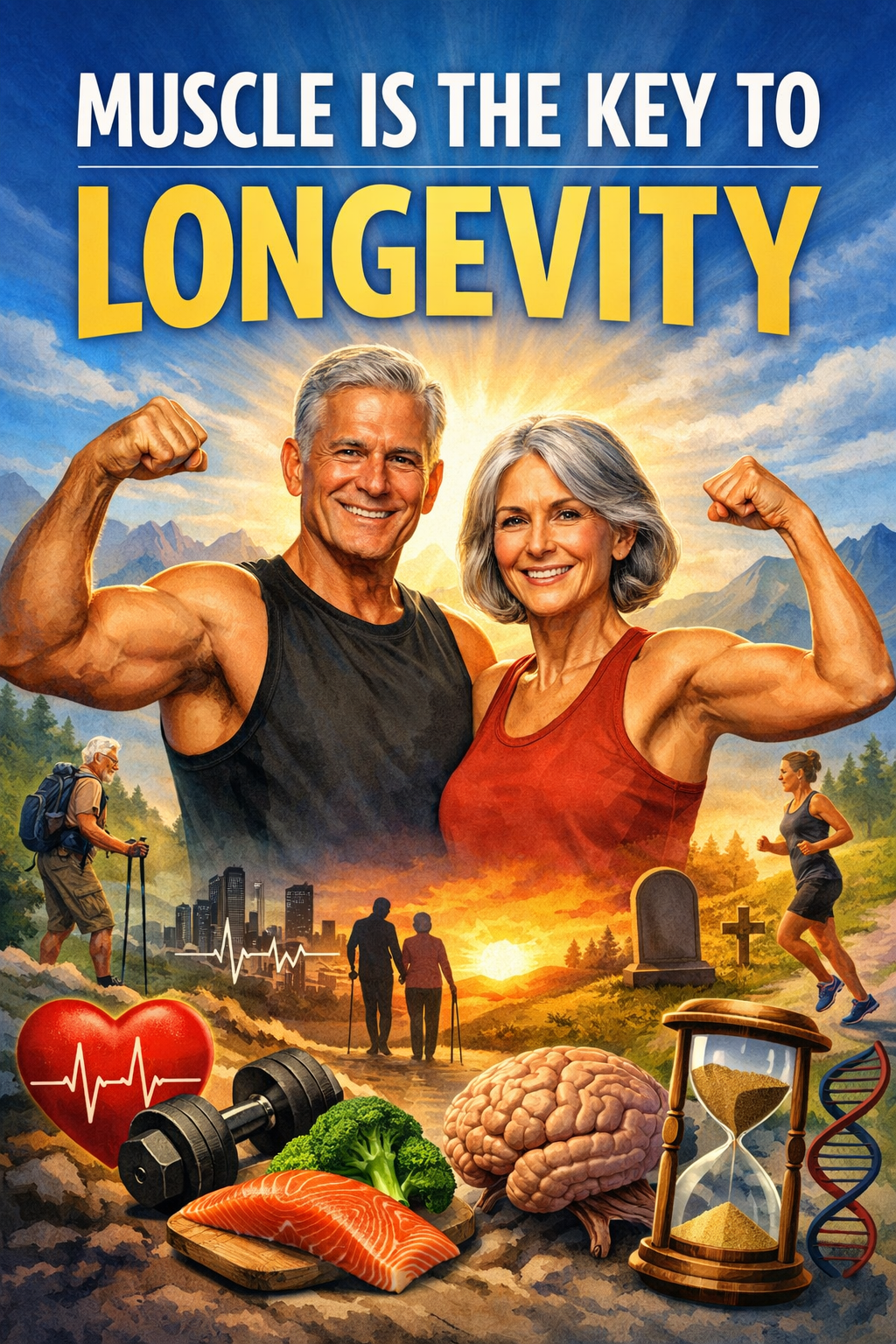
Muscle is one of the strongest predictors of how long—and how well—we live.
Not just muscle size, but muscle strength, power, and function.
This matters deeply for adults in midlife and beyond, because muscle is what protects independence, prevents falls, stabilizes blood sugar, supports bones, and gives us the physical reserve to handle illness, injury, and stress.
The good news?
You do not need a personal trainer, a gym membership, or hours a day to build and maintain muscle.
Why muscle is so tightly linked to longevity
Strength predicts survival
Large population studies consistently show that people with lower muscular strength have higher rates of all-cause mortality and cardiovascular disease—even when accounting for age, smoking, and aerobic fitness.
Strength isn’t just about movement. It reflects:
- nervous system health
- metabolic health
- resilience to stress and illness
- physical reserve as we age
In other words, strength is a snapshot of how well the body is functioning as a whole.
Grip strength: a surprisingly powerful health marker
Grip strength is often used in research because it’s simple to measure—but it correlates strongly with:
- overall muscle strength
- mobility and balance
- risk of disability
- risk of death
Weak grip strength is associated with higher rates of cardiovascular disease, hospitalization, and frailty. Stronger grip, on the other hand, often signals better whole-body strength and coordination.
The takeaway: your hands tell a bigger story than you think.
Muscle protects you as you age
After age 30, adults naturally lose muscle each decade unless they actively train it. This loss accelerates after 50 and again after 65.
Why that matters:
- Less muscle = less balance and stability
- Less muscle = greater risk of falls and fractures
- Less muscle = harder recovery from illness, surgery, or injury
Strength training doesn’t just slow this process—it can reverse much of it, even later in life.
How to build muscle without a personal trainer
You don’t need complexity. Muscle responds to challenge, not perfection.
The fundamentals:
- Use resistance (bodyweight, dumbbells, bands, backpacks, machines)
- Train close to effort (the last few reps should feel challenging)
- Progress slowly over time (a few more reps, a little more weight)
- Stay consistent (2–3 days/week beats everything else)
That’s it.
Beginner strength exercises (safe, effective, and scalable)
These movements build the most muscle with the least risk—and they translate directly to real life.
Lower body (legs + hips)
- Chair squats / sit-to-stands
- Step-ups (stairs count)
- Split squats (holding onto support is fine)
- Glute bridges
Why they matter: strong legs reduce fall risk, protect knees and hips, and support bone density.
Upper body
- Wall or counter push-ups
- Dumbbell or band rows
- Overhead presses (seated or standing)
Why they matter: upper-body strength supports posture, shoulder health, and daily tasks like lifting, carrying, and reaching.
Core and carries
- Planks or dead bugs
- Farmer carries (holding weights, grocery bags, or kettlebells and walking)
Carries are especially powerful—they improve grip strength, posture, core stability, and walking confidence all at once.
If you used to work out but it’s been a while
The biggest mistake people make returning to strength training is doing too much, too soon.
A smarter approach:
- Start at 60–70% effort for the first 2–3 weeks
- Leave a few reps “in the tank”
- Train 2 days/week at first
This allows joints, tendons, and connective tissue to adapt—so strength builds without injury.
Why jumping matters for bones
Bones need impact and load to stay strong.
Walking is excellent for health, but it doesn’t provide enough stimulus to maintain bone density on its own—especially in the hips and spine.
Jumping creates brief, higher-force signals that tell bones:
“We need to stay strong.”
Research shows that appropriately designed impact training can help support bone strength, especially when combined with resistance training.
How to jump safely for bone health (at any level)
Jumping doesn’t mean aggressive box jumps or high-impact workouts.
Entry-level options
- Heel drops: rise onto toes → drop heels firmly
- Strong marching (emphasize foot strike)
- Low step-downs
Moderate impact
- Small pogo jumps (tiny ankle hops)
- Low-amplitude jumping jacks
- Side-to-side hops
Higher impact (only if joints tolerate well)
- Jump rope (or pretend rope)
- Squat jumps with soft landings
A simple target:
40–100 total landings, 2–3 times per week, broken into small sets.
If someone has osteoporosis, joint issues, or pelvic floor concerns, strength training should come first, and impact should be individualized.
How lifting weights also strengthens bones
Muscle pulls on bone. Heavier loads = stronger signal.
Exercises that are especially bone-friendly:
- Squats and sit-to-stands
- Lunges and step-ups
- Deadlifts and hip hinges
- Loaded carries
For many adults—especially women in midlife—getting stronger first is the safest and most effective path before adding jumping.
The bottom line
Muscle is not about vanity.
It’s about freedom, resilience, and independence.
- Strong muscles protect your heart, metabolism, and bones
- Grip strength reflects whole-body health
- Jumping and lifting together support skeletal strength
- You can start at any age with minimal equipment
You don’t need extremes.
You need consistency, progress, and confidence that your body can adapt. And it can.