Fasting is often portrayed as a modern wellness trend, a biohack, or an extreme health practice. But when examined through the lens of human history, fasting is none of those things. It is a biological rhythm that appears repeatedly across civilizations, religions, and cultures that developed independently of one another. Long before insulin, glucose meters, or metabolic research existed, humans observed that periods without food created clarity, resilience, and internal balance.
Modern science has not invented the biology of fasting. It has confirmed it.
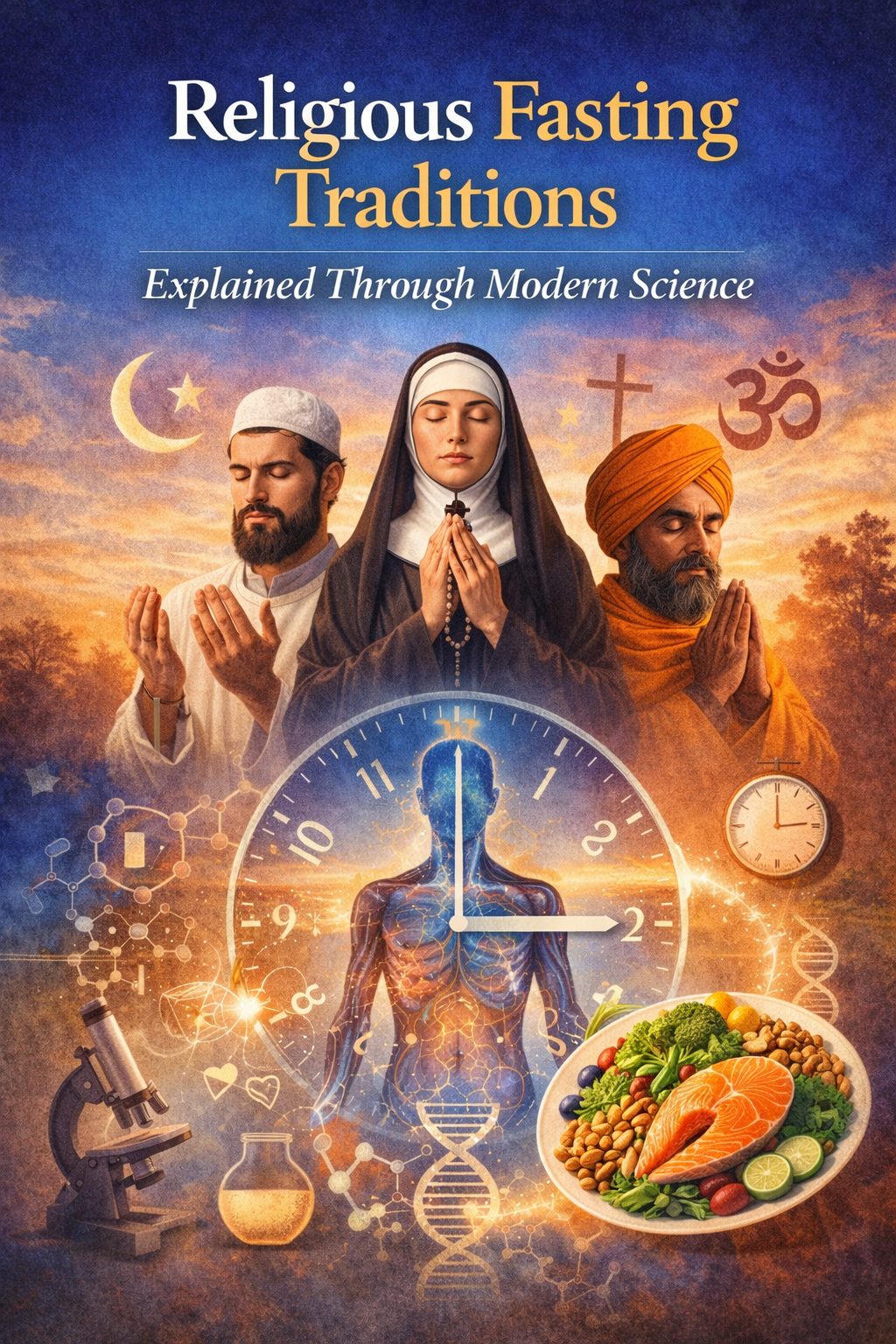
Across Judaism, Christianity, Islam, Buddhism, and Hinduism, fasting practices evolved in structured, intentional ways that align closely with what we now understand about metabolism, inflammation, insulin sensitivity, nervous system regulation, and energy balance. These traditions did not encourage chronic starvation or self-punishment. Instead, they created defined periods of restraint followed by nourishment, reinforcing metabolic flexibility rather than breaking the body down.
Understanding religious fasting through modern physiology helps dismantle fear-based narratives around fasting and replaces them with something far more grounded: respect for human design.
Jewish fasting traditions are among the most precisely structured examples of fasting in human history. The most well-known fasts, Yom Kippur and Tisha B’Av, last approximately twenty-five hours and involve abstention from both food and water. While this may sound extreme at first glance, the biological context tells a very different story.
These fasts are short, infrequent, and clearly bounded. They begin in the evening and end the following night, and Jewish law explicitly exempts individuals for whom fasting would be harmful, including pregnant women, children, the elderly, and the ill. This alone demonstrates that Jewish fasting was never intended to override physiology or prove endurance.
From a metabolic standpoint, a twenty-four to twenty-five hour fast reliably moves the body through glycogen depletion and into early ketosis. Human metabolic studies show that insulin levels fall significantly and fat oxidation increases between eighteen and twenty-four hours of fasting. This window allows stored energy to become accessible without pushing the body into prolonged stress or muscle breakdown.
Modern fasting research now highlights this same timing as metabolically beneficial. Jewish fasting traditions intuitively respected the balance between metabolic activation and recovery long before the science existed to explain it.
The absence of water during these fasts is also often misunderstood. Short-term water restriction within a twenty-four hour window is physiologically distinct from prolonged dehydration. Healthy adults can tolerate brief periods of reduced fluid intake without kidney injury when fasting occurs in a low-stress, reflective context. Duration, environment, and recovery matter.
Jewish fasting functioned as a reset, not a punishment. It created metabolic quiet, then deliberately returned the body to nourishment and community.
Christian fasting is frequently misrepresented in modern wellness culture, particularly through the promotion of multi-week fasts that are incorrectly attributed to biblical tradition. Historically, Christian fasting looked nothing like prolonged water fasting.
Early Christian fasting practices were inherited from Jewish tradition and emphasized dietary restraint rather than starvation. Lent, often described as a forty-day fast, was never intended to be a forty-day water fast. Instead, it involved reducing meal frequency, eliminating rich foods such as meat, sugar, and alcohol, and extending daily fasting windows.
Physiologically, this pattern resembles what modern science now calls time-restricted eating. Research shows that extending daily fasting windows improves insulin sensitivity, glucose regulation, and inflammatory markers even when total calorie intake remains unchanged. Lent created repeated daily cycles of metabolic unloading rather than a single prolonged fast.
Eastern Orthodox Christianity offers further insight into structured fasting rhythms. Orthodox fasting periods involve removing animal products and limiting meal frequency during specific times of the year. Studies conducted in Mediterranean and Eastern European populations have shown that Orthodox fasting patterns are associated with improved lipid profiles, reduced inflammation, and better insulin regulation, often without weight loss.
This distinction matters. It reinforces that fasting benefits are driven by hormonal signaling and metabolic timing, not simply by eating less.
The modern concept of a “21-day fast” does not originate from Christian tradition. There is no historical or scriptural evidence supporting a twenty-one day continuous water fast as a Christian practice. Most contemporary versions are partial fasts, elimination diets, or modern wellness challenges layered onto religious language.
Extended fasts beyond five to seven days were historically rare, situational, and often supervised. Christian fasting emphasized restraint and awareness, not physiological breakdown. Early Christian writings frequently cautioned against excessive fasting, noting that weakening the body undermines clarity rather than enhancing it.
Christian fasting worked because it respected human limits while still creating metabolic and mental quiet.
Ramadan fasting is one of the most extensively studied fasting practices in the world. Each year, hundreds of millions of people participate in a structured daily fast lasting approximately twenty-nine to thirty days. This provides researchers with a rare opportunity to study fasting at scale in free-living populations.
During Ramadan, food and drink are avoided from dawn until sunset, with eating occurring at night. This is not an extended fast, but a repeated daily fasting rhythm.
Research consistently shows that Ramadan fasting improves insulin sensitivity, lipid profiles, and inflammatory markers even when calorie intake remains similar. Many studies report reductions in triglycerides and LDL cholesterol, increases in HDL cholesterol, and improvements in glucose regulation.
One of the most compelling findings is that these benefits often occur without weight loss. In some cases, individuals gain weight during Ramadan yet still show improved metabolic markers. This reinforces the principle that timing matters more than calorie math.
Ramadan fasting also enhances metabolic flexibility by repeatedly shifting the body toward fat metabolism during the fasting window. While Ramadan does not typically induce deep ketosis, it trains the body to switch fuel sources efficiently.
Circadian biology plays a role here. Ramadan shifts eating to nighttime hours, which can disrupt sleep if not managed carefully. Research suggests that when sleep and meal quality are protected, metabolic benefits are preserved. Islamic law explicitly exempts individuals who would be harmed by fasting, again reinforcing that fasting was never meant to compromise health.
Ramadan demonstrates that daily fasting rhythms, practiced consistently and within community, can produce profound metabolic benefits without prolonged deprivation.
Buddhist fasting traditions offer a powerful example of how timing alone can influence metabolic and neurological health. In many Buddhist traditions, particularly among monastics, food is consumed only in the morning hours, often ending by noon. Solid food is avoided for the remainder of the day and night.
This practice mirrors what modern research identifies as early time-restricted eating. Studies show that eating earlier in the day improves insulin sensitivity, blood pressure, and oxidative stress markers independent of calorie intake.
Ending food intake early reduces evening insulin exposure, improves overnight fat oxidation, and supports circadian alignment. This pattern appears particularly beneficial for women, who often respond better to fasting strategies that emphasize earlier eating windows rather than prolonged evening fasting.
Buddhist fasting is also closely tied to nervous system regulation. Digesting food is metabolically demanding. When digestion quiets, parasympathetic activity increases, supporting emotional regulation and lower baseline stress hormones. When paired with calm environments and mindfulness practices, fasting is interpreted by the body as restoration rather than threat.
Hindu fasting traditions emphasize cyclical restraint rather than prolonged deprivation. One of the most common fasts, Ekadashi, occurs twice per lunar month and often involves avoiding grains and heavy foods while reducing overall intake.
From a metabolic standpoint, these recurring fast days function as regular insulin resets. Research on intermittent fasting and periodic caloric reduction shows improvements in glucose regulation and inflammatory balance over time, even when individuals eat normally on non-fast days.
Navratri, another significant fasting period, involves dietary simplification for nine days. During this time, many people avoid processed foods, alcohol, and meat, focusing instead on simple, easily digestible meals. This temporarily reduces insulin demand and inflammatory load while maintaining nourishment.
Hindu fasting traditions also emphasize hydration, flexibility, and communal reintegration through feasting after fasting periods. This reinforces metabolic resilience rather than chronic stress.
Across religions, a clear pattern emerges. None of these traditions promoted chronic starvation. None encouraged fasting without boundaries. None disconnected fasting from rest, community, or refeeding.
They worked because they aligned with human biology.
Fasting quiets digestion. Insulin exposure decreases. Inflammation softens. The nervous system recalibrates. Metabolic flexibility improves.
Modern science now explains what religious traditions observed experientially for thousands of years.
Fasting is not about control, punishment, or deprivation. It is about rhythm. When used intentionally, cyclically, and with respect for human physiology, fasting allows the body to do what it was designed to do.
If you’re interested in using fasting as a tool for metabolic health — not as a rule or an extreme — education matters.
To learn more about fasting, nourishment, hormone-supportive nutrition, and lifestyle alignment, visit LarsonNutrition.com. You can also explore hormone-safe skincare and candles designed to support healing environments at LarsonBotanicals.com.