Cognitive decline is often treated as an inevitable part of getting older, something we are expected to accept with quiet resignation. Forgetfulness, brain fog, slower processing, and memory lapses are brushed off as “normal aging,” especially in midlife and beyond.
But modern neuroscience tells a very different story.
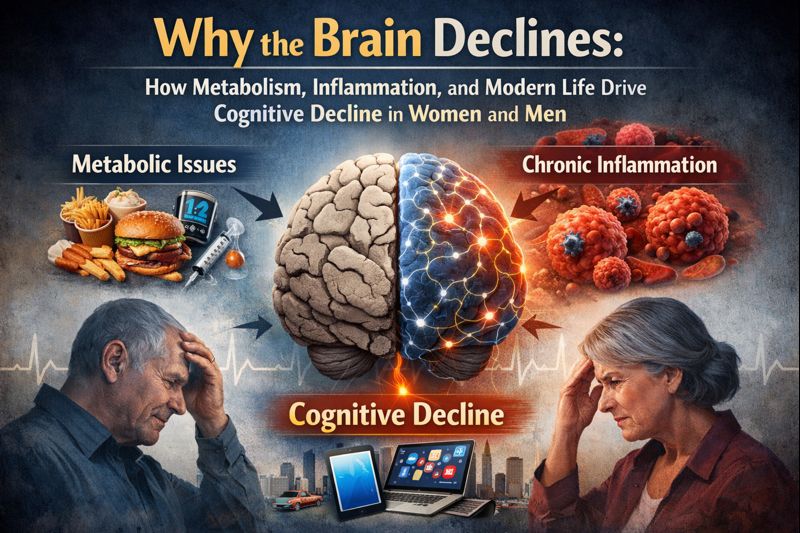
Most cognitive decline does not begin suddenly, and it does not begin in the brain alone. The biological processes that contribute to dementia and Alzheimer’s disease often start decades earlier, driven by metabolic dysfunction, chronic inflammation, impaired energy production, and lifestyle patterns that slowly erode brain resilience over time.
Understanding why the brain declines is the first step toward protecting it.
Dementia is not a single disease. It is a clinical term used to describe a group of symptoms that interfere with daily life, including memory loss, impaired reasoning, language difficulties, and changes in behavior.
Alzheimer’s disease is the most common cause of dementia, but it is far from the only one. Vascular dementia, Lewy body dementia, and frontotemporal dementia are also common, and many people have a combination of these pathologies.
This matters because mixed dementia points to a larger truth: cognitive decline is rarely caused by one isolated factor. It is the result of overlapping metabolic, vascular, immune, and neurological stressors acting together over time.
One of the most misunderstood phrases in brain health research is the idea that Alzheimer’s disease is “type 3 diabetes.” This is not an official medical diagnosis, but a research framework used to describe a consistent biological finding: many brains affected by Alzheimer’s disease show impaired insulin signaling and insulin resistance within brain tissue.
Insulin is not just a blood sugar hormone. In the brain, insulin plays a role in neuronal survival, synaptic plasticity, learning, memory, and energy metabolism. When neurons become resistant to insulin’s signal, glucose utilization becomes inefficient, even when blood sugar levels appear normal.
This means someone can have “normal” labs and still experience an energy crisis in the brain.
Brain imaging studies using PET scans consistently show reduced glucose metabolism in memory-related brain regions years—sometimes decades—before cognitive symptoms appear. This brain glucose hypometabolism is one of the earliest detectable changes in Alzheimer’s disease.
In simple terms, the brain struggles to access the fuel it needs to function.
The brain is one of the most energy-demanding organs in the human body. Even small disruptions in energy availability can affect focus, mood, processing speed, and memory.
When insulin resistance, inflammation, and mitochondrial dysfunction interfere with glucose metabolism, neurons produce less energy and more oxidative stress. Synapses—the connections between neurons where learning and memory occur—are especially vulnerable to this energy deficit.
This is why early cognitive symptoms often look like fatigue, brain fog, irritability, or slower thinking rather than obvious memory loss. By the time memory problems become severe, the underlying metabolic dysfunction has often been present for many years.
Chronic low-grade inflammation is one of the strongest drivers of cognitive decline. Unlike acute inflammation, which helps the body heal, chronic inflammation quietly alters signaling pathways throughout the body and brain.
The brain’s immune cells, called microglia, become chronically activated in the presence of ongoing inflammation. Instead of protecting neurons, they begin to damage synapses and release inflammatory compounds that accelerate neurodegeneration.
This neuroinflammation does not originate only in the brain. It is fed by inflammation elsewhere in the body, particularly in the gut, adipose tissue, and vascular system.
The gut is a major immune organ, housing the majority of the body’s immune system. A healthy gut microbiome helps regulate inflammation, maintain gut barrier integrity, and produce compounds that support brain health.
When the gut microbiome is disrupted—a state known as dysbiosis—inflammation increases. Increased intestinal permeability allows inflammatory molecules like lipopolysaccharides to enter the bloodstream, triggering systemic immune activation.
These inflammatory signals reach the brain, activate microglia, impair insulin signaling, and worsen mitochondrial function. This is why chronic digestive issues are often associated with brain fog, anxiety, depression, and cognitive fatigue long before dementia develops.
Ultra-processed foods contribute to cognitive decline through multiple pathways. They rapidly spike blood sugar and insulin, promote insulin resistance, displace fiber and micronutrients, and disrupt the gut microbiome.
Many ultra-processed foods also contain additives and emulsifiers shown in experimental studies to impair gut barrier integrity and increase inflammation. Over time, this creates a biological environment that favors neurodegeneration rather than brain resilience.
This is not about perfection or restriction. It is about recognizing that modern food environments are biologically mismatched to the human brain.
The brain depends on a dense and delicate network of blood vessels to deliver oxygen and nutrients. Chronic inflammation damages blood vessels, impairs endothelial function, and reduces cerebral blood flow.
High blood pressure, insulin resistance, dyslipidemia, and chronic inflammation all increase the risk of vascular damage in the brain. This is why vascular dementia is so common—and why many people have both vascular and Alzheimer’s pathology.
Protecting cognitive health requires protecting cardiovascular and metabolic health at the same time.
Men and women experience cognitive risk differently, largely due to differences in hormones, fat distribution, and metabolic timing.
Men tend to develop visceral fat and insulin resistance earlier in life, increasing vascular and inflammatory risk. Women often experience metabolic protection during reproductive years due to estrogen, but this protection declines after menopause.
The menopausal transition is a critical vulnerability window for women. Declining estrogen affects insulin sensitivity, mitochondrial function, sleep quality, and inflammation. For women with existing metabolic stress, this shift can accelerate cognitive symptoms such as brain fog and memory changes.
Different paths, same biology.
The most important takeaway is this: cognitive decline is not a sudden event. It is the result of long-term biological stress.
Brain fog, mental fatigue, and subtle cognitive changes are not failures. They are signals. And signals provide an opportunity for intervention.
By addressing metabolic health, inflammation, gut function, sleep quality, and lifestyle patterns early, it is possible to support brain resilience and reduce long-term risk.
Waiting for memory loss is waiting too long. The brain begins adapting—and eventually struggling—years before symptoms appear.
Understanding the metabolic and inflammatory roots of cognitive decline shifts the conversation from fear to agency. Brain health is not about one supplement or one test. It is about patterns repeated consistently over time.
And those patterns are changeable.
Check out The Larson Health Podcast on YouTube and subscribe to get more content @TheCoachKimLarson. LarsonNutrition.com for this blog article and LarsonBotanicals.com for all of your organic ingredients skin care and candles, without hormone disrupters or toxins.