
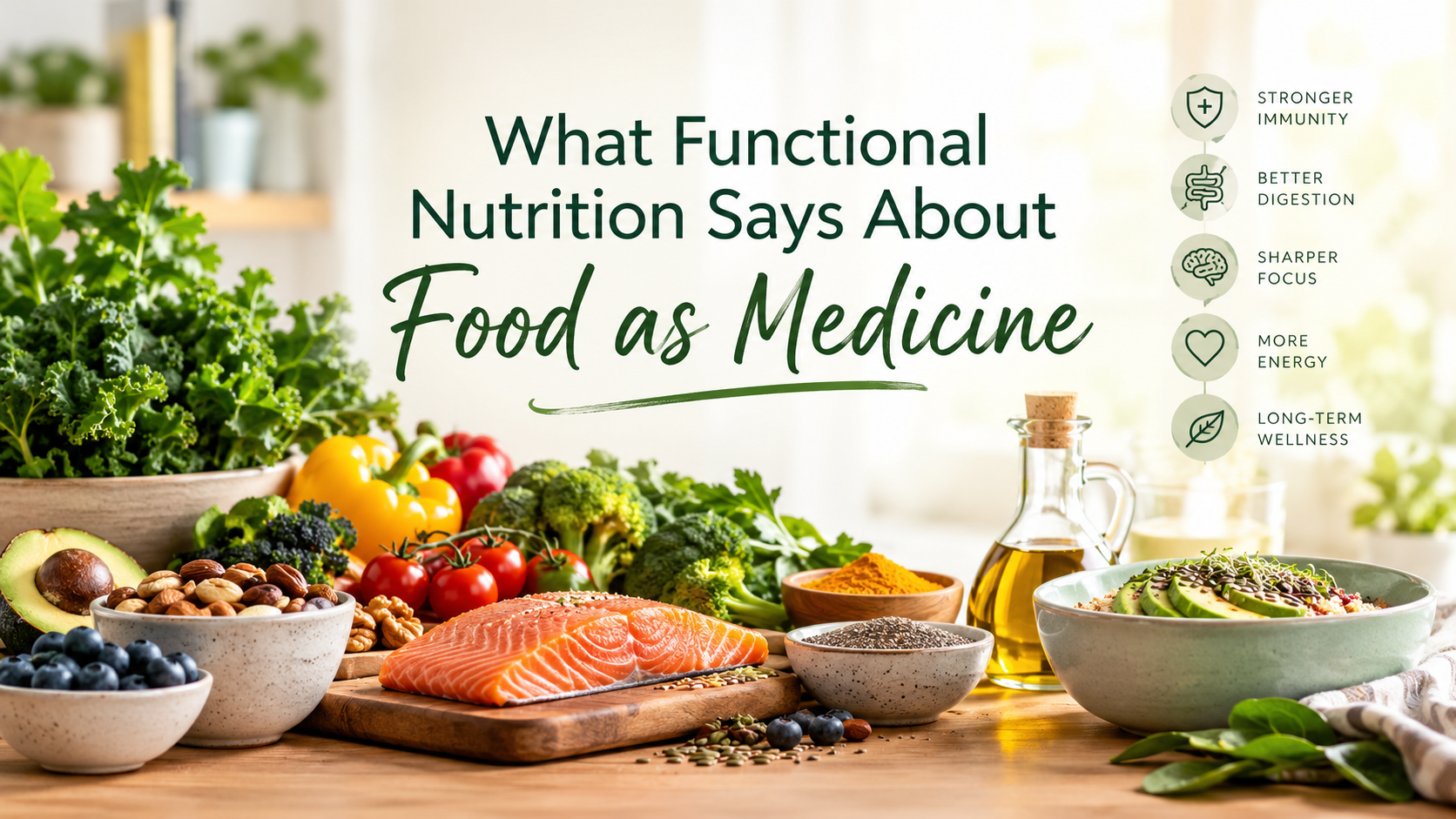
“Let food be thy medicine” is often credited to Hippocrates. Whether or not he actually said it, modern science is catching up to the idea. Doctors now write prescriptions for vegetables, hospitals deliver meals tailored to a diagnosis, and large clinical trials are measuring what happens when people change what’s on their plate.
Functional nutrition is an approach that treats food as a tool for supporting how the body works, not just as calories or a list of nutrients. Instead of asking only “what should I cut out?”, it asks: what’s driving this person’s symptoms, and how can diet, digestion, and lifestyle help address the root of the problem?
In this post, we’ll look at what functional nutrition says about using food as medicine, and how well the research backs it up: where the evidence for food as medicine is strong, where it’s promising, and where enthusiasm still runs ahead of the science.
A core idea in functional nutrition is that food sends signals to your body. What you eat affects your inflammation, blood sugar, hormones, and gut bacteria, not just your weight. That’s why the focus is on the overall pattern of eating rather than counting calories or chasing one “superfood.”
What the research says: The strongest support comes from PREDIMED, a large randomized trial of 7,447 Spanish adults at high risk of heart disease. People were assigned to a Mediterranean diet with extra-virgin olive oil, a Mediterranean diet with nuts, or a reduced-fat control diet. Both Mediterranean groups had about 30% fewer major cardiovascular events, such as heart attack, stroke, and cardiovascular death. Calories weren’t restricted. The kind of food changed the outcome.
(One note for accuracy: the trial was retracted and republished in 2018 after problems were found in how some participants were randomized. After reanalysis, the results held up.)
The same idea shows up in “food is medicine” programs. In a 2023 Tufts-led analysis of nine produce prescription programs across 12 states, doctors “prescribed” fruits and vegetables. Adults with diabetes saw their HbA1c (a three-month blood sugar marker) drop by about 0.3 points, and systolic blood pressure fell by more than 8 mm Hg among those with high blood pressure. That study had no control group, so it’s promising rather than proven, and randomized trials are underway.
Functional nutrition asks why a condition developed, not only how to manage it. High blood sugar, for example, is treated as a signal of something upstream, not just a number to bring down with medication.
What the research says: Type 2 diabetes is a strong example. Researchers in the UK found that excess fat inside the liver and pancreas plays a key role in the disease, and that losing weight to reduce that fat lets those organs control blood sugar properly again.
They tested this in the DiRECT trial. People diagnosed within the past six years followed a structured, low-calorie program, then gradually returned to regular food with support. After one year, 46% were in remission and off diabetes medication, compared with 4% of the control group. Among those who lost 15 kg (about 33 lb) or more, 86% reached remission.
Addressing the root cause changed the course of a disease once thought to only get worse. The honest caveat: by five years, many people had regained weight and fallen out of remission. Root-cause work isn’t a one-time fix. It takes ongoing support.
In functional nutrition, the gut is often the first place to look. The trillions of bacteria living there help digest food, train the immune system, and influence inflammation throughout the body. A more diverse gut community is generally considered a healthier one.
What the research says: A 2021 Stanford study published in Cell put this to the test. Healthy adults spent 10 weeks eating either a high-fiber diet or a diet high in fermented foods. People eating yogurt, kefir, kimchi, fermented vegetables, and kombucha saw greater gut microbial diversity, with larger servings producing stronger effects. Across that group, 19 inflammatory proteins went down, including interleukin-6, a marker linked to many chronic diseases.
This supports one of functional nutrition’s central claims: changing what you eat can calm inflammation by changing your gut, and it can happen within weeks. The study was small and in healthy adults, so researchers are now testing whether the same benefits hold for people with chronic conditions.
Functional nutrition rejects the idea of a single “perfect diet.” Your genetics, gut bacteria, health history, and lifestyle all shape how you respond to food. The goal is a plan built for the person, not the average.
What the research says: The same Stanford study offers a striking example. The high-fiber group didn’t see the across-the-board benefits the fermented-food group did. Fiber changed what the gut microbes could do, but it didn’t raise diversity or lower those inflammatory markers overall, and responses varied widely from person to person. Fiber is still healthy. It just doesn’t act the same way in every gut.
Personalization also shows up in medically tailored meals, ready-to-eat meals designed by a registered dietitian for someone’s specific condition, such as heart failure, diabetes, or kidney disease. In a 2019 JAMA Internal Medicine study, people receiving 10 tailored meals a week had about half as many hospital admissions as similar people who didn’t. Researchers estimated monthly medical costs were about 16% lower: $3,838 versus $4,591 per person.
And recall DiRECT: remission depended heavily on how much weight each person lost. Same program, very different outcomes. That’s bio-individuality in action.
At its best, functional nutrition puts whole foods first and treats supplements and specialty testing as tools, not the foundation. Every major result in this article came from real food and eating patterns, not pills.
Where caution is needed: This is also where parts of the functional world run ahead of the science.
A trustworthy functional nutrition practitioner will explain the evidence behind each recommendation and be clear about what’s proven and what’s still experimental.
The research above tests individual principles. Studies of functional nutrition and functional medicine as a complete approach are newer, but they’re starting to appear.
The most cited comes from the Cleveland Clinic, which opened a Center for Functional Medicine inside a major academic hospital. A 2019 study in JAMA Network Open compared 1,595 of its patients with 5,657 patients from a regular family health center. About 31% of functional medicine patients improved their physical health scores by a clinically meaningful amount, compared with 22% in primary care. The scores came from PROMIS, a standard NIH-backed questionnaire.
That’s encouraging, but it was a look back at existing patient records, not a randomized trial. The researchers themselves said future prospective studies are needed. People who choose functional care may also differ in motivation, time, or resources. The fairest summary: the individual principles have solid support, and the overall model looks promising but still needs stronger trials.
You don’t need a lab panel or a supplement cabinet to start. Each principle translates into a simple habit:
Functional nutrition says food is one of the most powerful tools we have for health, and much of the research agrees. Eating patterns, gut-supporting foods, and tackling root causes like excess weight can lower blood pressure and blood sugar, calm inflammation, reduce hospital stays, and even reverse some chronic disease. The approach is at its best when it pairs that personalized, root-cause thinking with honest standards of evidence.
This article is for general education and isn’t medical advice. Talk with your doctor or a registered dietitian before making major changes to your diet, especially if you have a chronic condition or take medication.













One Response
Good stuff, loved the information