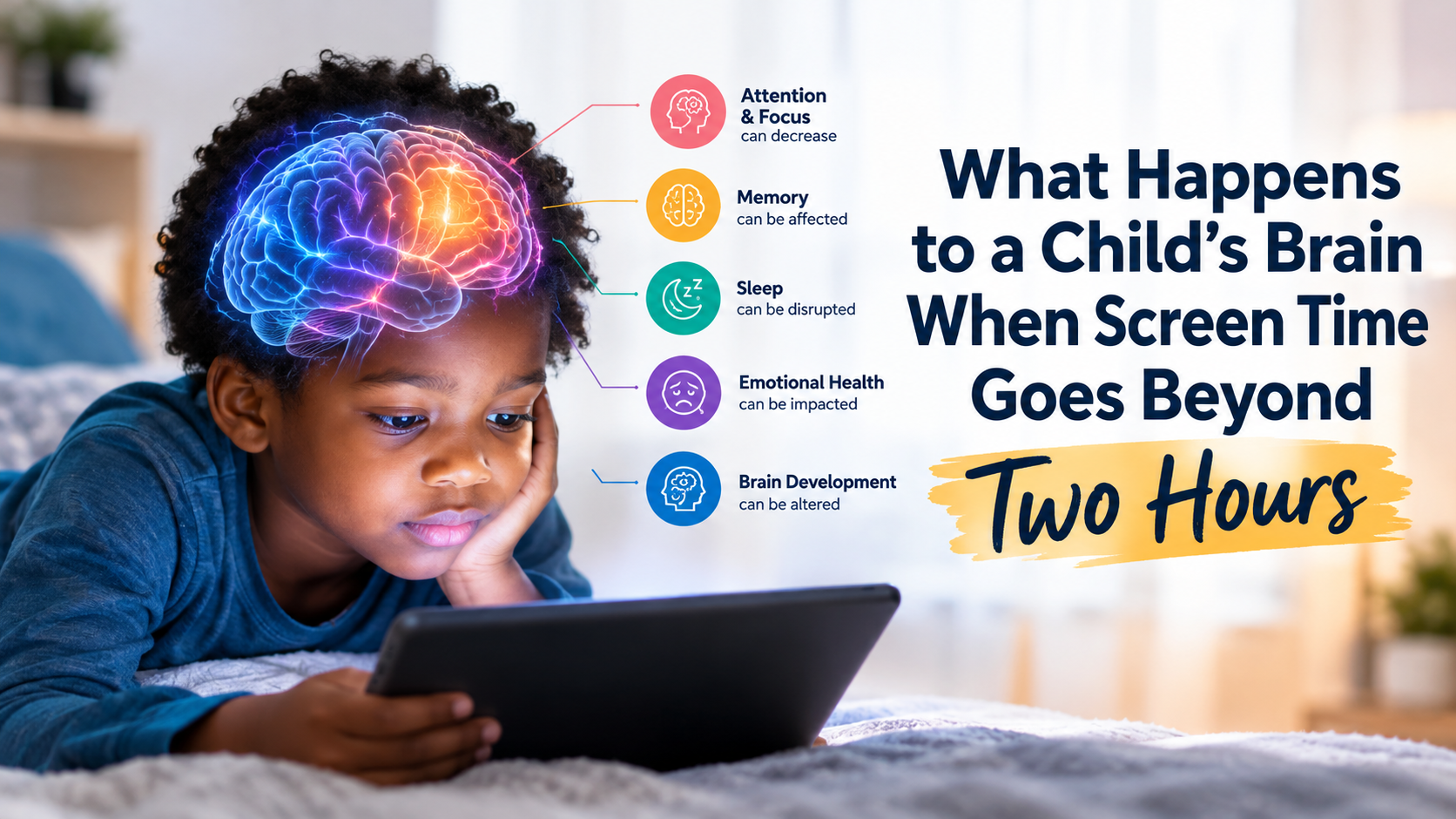
What one of the largest studies of child brain development tells us about screens, sleep, movement, and cognition
The Two-Hour Question
Phones, tablets, video games, streaming, YouTube and social media are now woven into childhood. That makes an important question increasingly relevant for parents: how much recreational screen time is too much for a developing brain?
One of the most frequently cited answers comes from research using the National Institutes of Health-supported Adolescent Brain Cognitive Development (ABCD) Study. The ABCD Study began with nearly 12,000 children ages 9 and 10 at 21 U.S. research sites and is following them through adolescence into young adulthood.
What the Research Found
In a 2018 analysis published in The Lancet Child & Adolescent Health, researchers studied 4,524 children ages 9 to 10. They examined whether the children met three recommendations: no more than two hours per day of recreational screen time, 9–11 hours of sleep per night, and at least 60 minutes of physical activity per day.
Children who met more of these recommendations had better global cognition. Meeting the screen-time recommendation—and particularly the combination of the screen-time and sleep recommendations—was associated with better cognitive performance.
The testing assessed important areas of cognition such as memory, attention, language, processing and executive function.
Does the Brain Become “Overloaded” After Two Hours?
Not literally. The study did not demonstrate that a child’s brain suddenly becomes overloaded or damaged when the clock reaches two hours. Two hours was the recreational screen-time guideline researchers used when comparing the children.
This was an observational, cross-sectional analysis. It found an association between lower recreational screen exposure and better cognitive performance, but it could not prove that exceeding two hours directly caused poorer cognition.
So the scientifically accurate message is not “two hours and one minute damages the brain.” The more useful takeaway is that keeping recreational screen use within reasonable limits may help preserve time for behaviors a developing brain needs.
What Screen Time May Be Replacing
Every child has only 24 hours in a day. Heavy recreational screen use can compete with sleep, physical movement, face-to-face interaction, outdoor activity, reading, creative play and unstructured downtime.
That is one reason the ABCD research is so useful: it considers screen exposure alongside sleep and physical activity rather than treating screen time as the only factor influencing development.
What Brain-Imaging Research Adds
ABCD researchers have also used MRI data to examine relationships between screen-media activity and the developing brain. Research has identified associations between patterns of screen use and structural brain measures, along with small differences in some measures of cognition.
These findings are important, but they should not be translated into claims that screens simply “damage” the brain. Screen activity varies considerably, and an association in an observational study does not automatically establish cause and effect.
Not All Screen Time Is the Same
Two hours spent video-chatting with grandparents, creating something, learning a skill or completing an educational project is not necessarily equivalent to two hours of passive scrolling or rapidly changing short-form videos.
Interestingly, another NIH-supported ABCD analysis found that children who reported playing video games for three or more hours per day performed better on two specific cognitive tasks than children who reported no gaming. The researchers cautioned that the study could not establish cause and effect.
This illustrates why both the amount and the type of screen use matter.
A Practical Approach for Parents
For school-age children, roughly two hours of recreational screen time can be used as a practical daily benchmark rather than a biological cutoff.
Protect sleep first. School-age children generally need substantial nightly sleep, and screens should not routinely displace it.
Protect physical activity and real-world experiences. Children need movement, outdoor time, conversation, creative play and opportunities to be bored and entertain themselves.
Create screen-free periods, particularly around meals, family interaction and bedtime.
Pay attention to content as well as minutes. Creative, educational and socially interactive screen activities can be very different from prolonged passive consumption.
Watch the child, not only the timer. Difficulty stopping, sleep disruption, irritability, withdrawal from other activities or declining school performance may be more informative than an exact number of minutes.
The Bottom Line
The NIH-supported ABCD research gives parents a more nuanced message than the frightening claim that a child’s brain is “fried” after two hours.
In a large group of children, keeping recreational screen time to two hours or less per day was associated with better cognitive performance, particularly when healthy sleep and physical activity were also part of the child’s day.
The developing brain needs variety: sleep, movement, conversation, learning, creativity, exploration and real-world experiences. Screens can be part of childhood without becoming the activity that pushes those experiences aside.
Sources & Further Reading
Walsh JJ, et al. Associations between 24 hour movement behaviours and global cognition in a cross-sectional sample of US children. The Lancet Child & Adolescent Health. 2018. https://pmc.ncbi.nlm.nih.gov/articles/PMC6298223/
National Institute of Mental Health. Adolescent Brain Cognitive Development (ABCD) Study. https://www.nimh.nih.gov/research/research-funded-by-nimh/research-initiatives/adolescent-brain-cognitive-developmentsm-study-abcd-studyr
Paulus MP, et al. Screen Media Activity and Brain Structure in Youth: Evidence for Diverse Structural Correlation Networks from the ABCD Study. NeuroImage. 2019. https://pmc.ncbi.nlm.nih.gov/articles/PMC6487868/
National Institutes of Health. Video gaming may be associated with better cognitive performance in children. 2022. https://www.nih.gov/news-events/news-releases/video-gaming-may-be-associated-better-cognitive-performance-children
Educational note: This article is for general educational purposes and is not individualized medical advice.