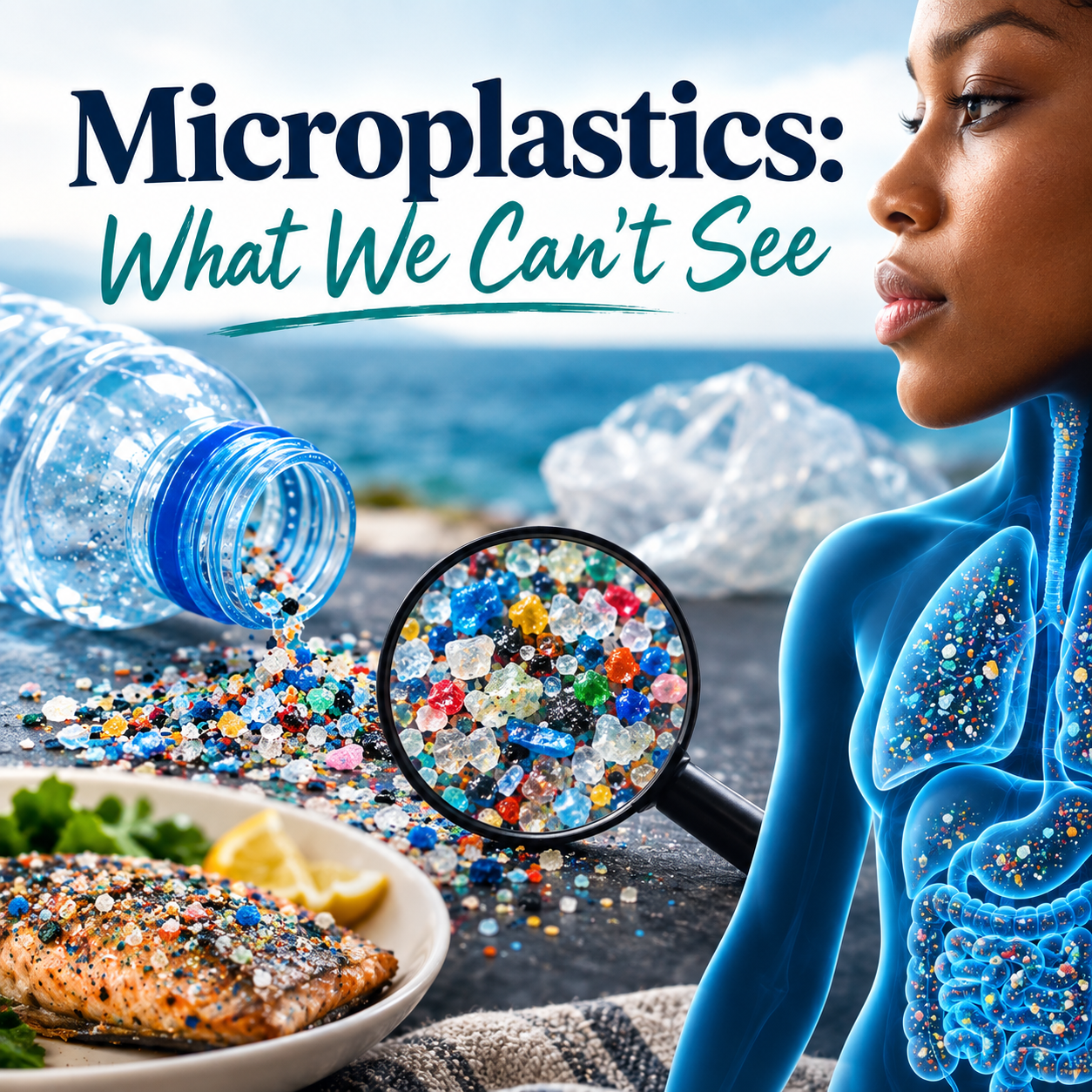

How everyday items are quietly loading your body with plastic — and what the research actually says about it.
Picture a normal morning. You get dressed in a cotton blend that has a little spandex woven in for stretch. You grab a coffee in a paper cup with a thin plastic lining, maybe pop a piece of gum on your way out the door, and grab a bottle of water for the commute.
Nothing about that morning feels unusual. But in that half hour, you’ve likely swallowed, inhaled, or absorbed thousands of microscopic pieces of plastic — not as a scare-tactic estimate, but as something researchers have actually measured, counted, and published in peer-reviewed journals.
This isn’t a niche concern anymore. Scientists have now found plastic particles in the human brain, liver, kidneys, heart, testicles, placenta, breast milk, blood, and even a newborn’s first stool. One researcher at Stanford summed up the situation bluntly: we are, in a very real sense, born already carrying plastic in our bodies.
So where is all of this actually coming from? This piece walks through the everyday sources — clothing, coffee cups, bottled water, food packaging, cookware, personal care products, and a handful of surprising smaller sources — and lays out what the current science does and doesn’t know about what it means for your health. It’s a lot to cover, but the goal is simple: understand where the biggest, easiest reductions are, without needing a chemistry degree or a total lifestyle overhaul to get there.
A quick note before diving in: this is a fast-moving research area. New studies on detection methods, exposure estimates, and health associations are being published every few months, and some of the numbers below will likely be revised as measurement techniques keep improving — the bottled water findings later in this piece are a good example of just how much a single better instrument can change the picture. Treat the specific figures as a snapshot of where the science stood as of mid-2026, not a final word.
Let’s start with clear definitions, because these terms get thrown around loosely.
Microplastics are plastic fragments smaller than 5 millimeters — roughly the size of a grain of rice down to something you’d need a microscope to see. Nanoplastics are smaller still, measured in billionths of a meter. For comparison, a human hair is about 70 micrometers wide; nanoplastics can be a thousand times smaller than that.
The size difference matters enormously for how these particles behave in the body. Microplastics are generally too large to cross most cell membranes, so much of what you ingest simply passes through your digestive system. Nanoplastics are a different story. Because they’re so small, they can cross the intestinal wall and the lining of the lungs directly into the bloodstream, and from there travel to organs including the heart and brain. This is part of why the discovery of massive nanoplastic counts in everyday items — like bottled water — alarmed researchers more than earlier microplastic findings did.
Both microplastics and nanoplastics come from the same underlying sources: they’re what’s left when larger plastic items break down. Sunlight, heat, friction, and mechanical wear all accelerate that breakdown, which is why so many of the sources below involve one of those four conditions.
Estimates vary a lot depending on methodology, but a synthesis of more than 140 scientific articles, published in the Journal of Hazardous Materials in late 2025, put the average person’s annual ingestion of microplastic particles somewhere between 39,000 and 52,000 particles per year from food and drink alone — and that estimate climbs considerably higher for people who rely heavily on bottled water, since bottled water itself is one of the most concentrated sources studied so far.
To be clear about what these numbers do and don’t mean: a lot of media coverage has translated cumulative estimates into vivid comparisons — a credit card’s worth of plastic per week is one that circulated widely a few years ago. Toxicologists have since pushed back on the precision of that specific number, and it’s worth treating any single headline figure with some skepticism. What’s not in dispute, across dozens of independent studies using different methods, is the underlying pattern: plastic particles are turning up in food, drink, air, dust, and human tissue far more often, and in far greater quantities, than anyone assumed a decade ago.
Most people don’t think of their wardrobe as a plastic problem, but polyester, nylon, acrylic, and spandex are all forms of plastic. Every wash cycle of a synthetic garment sheds thousands of microscopic fibers into the wash water. Wastewater treatment plants aren’t designed to filter fibers this small, so a meaningful share ends up in rivers, oceans, and — through the sludge byproduct that often gets applied to farmland as fertilizer — back into soil.
It’s not just the washing machine, though. Ordinary wear sheds fibers into the air around you through simple friction, and those fibers settle into household dust. Indoor spaces that lean heavily on synthetic material — wall-to-wall carpet, upholstered furniture, polyester curtains — tend to show measurably higher microplastic concentrations in indoor air and dust than spaces built around natural fiber. Cotton, linen, wool, silk, and bamboo all break down as ordinary organic matter instead of persisting as plastic for centuries.
The trap here is that a lot of ‘natural-feeling’ fabric is actually a blend, and blends don’t advertise themselves clearly. A shirt can be eighty percent cotton and twenty percent polyester and still shed plastic fiber every time it goes through the wash. If reducing your synthetic fiber exposure matters to you, checking the tag before you buy is a more reliable habit than trusting how a fabric feels in the store.
This is one of the more surprising findings in the whole space. A 2024 study out of Turkey tested four common disposable cup materials — polypropylene, polystyrene, expanded polystyrene foam, and the standard polyethylene-lined paper cup — at a range of temperatures and contact times. Every single material released measurable microplastic particles into the liquid inside it. Particle counts ranged from around 126 particles per liter on the low end up to 1,420 particles per liter, with the highest counts showing up in polypropylene cups held at 50 degrees Celsius for twenty minutes.
A separate, more recent 2026 study looking specifically at takeaway coffee and tea cups found the same underlying pattern: heat is the primary driver of particle release, and contact time makes it worse. Interestingly, both studies found that briefly rinsing a disposable cup with clean water before use cut microplastic release by roughly half — a small, easy habit if you’re stuck using a disposable cup anyway.
The detail that surprises most people is that the standard paper cup isn’t actually the safer option people assume it is. A paper cup only holds liquid because of a thin plastic lining bonded to the inside — usually polyethylene. That lining is precisely what’s shedding into your drink. Heat, acidity, and the mechanical action of the liquid moving around inside the cup all contribute to that shedding. So the ‘paper feels more natural’ intuition doesn’t actually track with what’s happening chemically.
The practical fix is genuinely simple, and it’s probably the single highest-leverage swap in this whole article: bring your own reusable cup. It sidesteps the entire mechanism, and unlike some of the other sources discussed below, this one is fully within your control every single day.
If coffee cups were surprising, bottled water findings from the last two years have been genuinely startling to researchers themselves.
A landmark January 2024 study from Columbia University, published in the Proceedings of the National Academy of Sciences, used a new laser-based imaging technique sensitive enough to detect particles as small as 100 nanometers — far smaller than anything earlier studies could measure. Testing three popular U.S. bottled water brands, the research team found an average of roughly 240,000 detectable plastic particles per liter, with individual samples ranging from about 110,000 to 370,000. About 90 percent of those particles were nanoplastics, the size class small enough to move directly into the bloodstream. That figure was ten to one hundred times higher than earlier estimates, simply because earlier detection methods couldn’t see particles that small.
A broader 2025 review in the Journal of Hazardous Materials, synthesizing more than 140 published studies, found wide variation in reported microplastic counts — from as few as 2 particles per liter to as many as roughly 6,600 particles per liter — and traced much of the contamination to the bottle’s neck and cap, along with degradation from sunlight exposure during storage and transport. That same review estimated that people who drink exclusively bottled water may ingest up to 90,000 additional microplastic particles per year compared to people who mostly drink tap water.
Which raises the obvious question: is tap water actually cleaner? The honest answer is ‘somewhat, but not zero.’ Municipal tap water has also been shown to contain nanoplastics in independent testing, so switching to tap water doesn’t eliminate exposure — it removes the specific extra contribution that comes from the plastic bottle and cap themselves. Most standard water filters aren’t rated to catch particles below about 1 micron, meaning a typical pitcher filter or refrigerator filter will miss the majority of nanoplastics. Reverse osmosis filtration is currently the most effective residential option for getting below that threshold, if that level of filtration matters to you.
The practical version: a reusable water bottle filled from the tap — filtered or not — is very likely lower in microplastic content than a disposable plastic bottle, and it avoids the sunlight-and-heat degradation that makes bottled water worse the longer it sits in a hot car or on a sunny counter.
Zooming out from cups and bottles specifically, a 2026 review of packaging-related exposure found something genuinely useful for figuring out where to focus your attention: exposure isn’t spread evenly across every type of plastic container. A relatively small number of packaging formats and conditions account for a disproportionate share of total exposure.
PET — polyethylene terephthalate, the clear rigid plastic used for water bottles, soda bottles, and a lot of clamshell food containers — accounts for something like a third of total packaging-related exposure on its own, more than any other single material. Two conditions dramatically increase how much a given piece of packaging sheds into its contents: sunlight exposure, which the research found can multiply particle release by up to two orders of magnitude — that is, up to roughly a hundred times more — and thermal stress, meaning hot-filling a container or microwaving food inside plastic, both of which weaken the material and accelerate particle detachment.
The practical takeaways translate directly: don’t leave plastic water bottles in direct sunlight or in a hot car for extended periods, and never microwave food in a plastic container — move it to glass or ceramic first, even if the plastic is labeled ‘microwave safe.’ That label typically refers to whether the container will physically melt or warp, not whether it will shed particles into your food.
A few kitchen items deserve their own mention, because they’re used daily and rarely discussed alongside packaging.
Nonstick cookware coated with PTFE — commonly known by the brand name Teflon — has been found in testing to release large numbers of microplastic and nanoplastic particles during normal cooking, especially as the coating scratches or degrades with age and use. This is a doubly relevant finding because PTFE coatings are also a type of PFAS, the class of synthetic ‘forever chemicals’ that persist in the environment and the body for extended periods. Stainless steel, cast iron, and ceramic-coated cookware are the standard alternatives, and all three avoid this particular mechanism entirely.
Plastic cutting boards are a related, less obvious source. Every time a knife blade drags across a plastic surface, it shaves off microscopic plastic particles that end up directly in whatever food you just cut. Wood and bamboo cutting boards don’t have this issue, since the material they shed is organic rather than synthetic.
A few sources that don’t get nearly enough attention, given how routine they are for a lot of people.
Many ‘premium’ pyramid-shaped tea bags are actually woven from a fine plastic mesh rather than traditional paper, chosen because it lets loose tea leaves unfurl more fully during steeping. Steeping one of these bags in near-boiling water — exactly the temperature most tea is brewed at — releases very high numbers of microplastic and nanoplastic particles directly into the cup. Loose-leaf tea brewed with a metal strainer, or tea bags specifically labeled as plastic-free, sidestep this issue completely.
The gum base in most commercial chewing gum is, chemically, a blend of plastic and synthetic rubber. One study found that a single gram of gum can release more than 600 microplastic particles during chewing, with the large majority of that release happening in the first eight minutes. Somewhat counterintuitively, the same research found that ‘natural’ gums made with plant-based polymers released a similar number of particles — suggesting that at least some of the contamination is introduced during manufacturing or packaging, rather than coming exclusively from the synthetic gum base itself. If you chew gum regularly, chewing one piece for longer rather than replacing it frequently reduces total exposure somewhat, simply because most of the release front-loads early in the chewing process.
Table salt is another surprising one. Testing across salt products sold worldwide has found microplastic contamination in roughly 94 percent of samples, making it one of the most consistently contaminated food ingredients studied. Interestingly, land-harvested salts — including well-known specialty salts like Himalayan pink salt — have tested higher in some studies than ocean-harvested sea salt, which runs counter to the intuition that salt pulled directly from the ocean would be more contaminated. Even the grinder you use matters: a disposable plastic salt or pepper grinder can shed several thousand particles just from the mechanical act of grinding a tenth of a gram of salt, simply due to plastic-on-plastic or plastic-on-salt abrasion inside the mechanism. A ceramic or metal grinder avoids that mechanism entirely.
This is a category most people don’t associate with plastic at all, but it’s a meaningful contributor, both to what ends up on your skin and what eventually washes down the drain.
Solid plastic microbeads — tiny spherical particles typically made of polyethylene or polypropylene — were once common in exfoliating face washes and body scrubs. The United States, the UK, Canada, and the EU all passed bans on microbeads specifically in rinse-off personal care products starting around 2015, and those bans have meaningfully reduced this particular source. However, the bans have two significant gaps that most consumers aren’t aware of. First, they only cover rinse-off products; leave-on products like lotion, sunscreen, foundation, and lipstick are not covered and can still legally contain added microplastics. Second, manufacturers have in many cases simply replaced solid microbeads with liquid polymers — ingredients like certain silicones, acrylates copolymers, and polyurethane dispersions — which serve a similar texturizing function but aren’t captured by a ban written around solid beads.
One study analyzing 144 personal care products found that about 70 percent contained at least one identifiable form of microplastic. Even in products designed to be rinsed off, some residue and nanoplastic fraction can remain on skin after rinsing, contributing to direct skin exposure in addition to environmental runoff.
If you want to reduce this source, checking ingredient labels for terms like polyethylene, polypropylene, polyurethane, acrylates, or generically ‘polymer’ is a reasonable starting point, though it’s an imperfect one — labeling requirements are inconsistent, and ‘fragrance’ or ‘parfum’ on a label can legally hide hundreds of undisclosed ingredients, some of which are microplastic-adjacent. Natural exfoliants — finely ground sugar, salt, or coffee grounds — accomplish the same texture goal as a plastic microbead scrub without the underlying material.
Menstrual products are a related, less-discussed example. Testing has found that a single tampon can release billions of micro- and nanoplastic particles, largely from synthetic fibers and plastic applicators. Product lines made from 100 percent cotton, without a plastic applicator, along with reusable options like silicone menstrual cups and cotton period underwear, avoid this mechanism.
A theme that runs through several sections above is worth naming directly: a large share of everyday microplastic exposure isn’t something you eat or drink at all — it’s something you breathe. Synthetic carpet, upholstery, curtains, and even some household cleaning products and air fresheners with polymer-based ingredients all contribute fine plastic particles to indoor air and the dust that settles on every surface in a home.
Because people in industrialized countries spend the overwhelming majority of their time indoors, indoor air quality on this front matters at least as much as food and drink sources, and arguably more, simply due to sheer exposure time. Regular vacuuming with a HEPA-filtered vacuum, reducing wall-to-wall synthetic carpet where practical, and favoring natural-fiber upholstery and curtains are the most commonly recommended mitigations, though none of them eliminate exposure entirely — they reduce the concentration you’re breathing on an average day.
This is the section where honesty about uncertainty matters most, because it’s easy to either overstate or dismiss what’s currently known.
The U.S. Government Accountability Office released a science spotlight report in July 2026 summarizing the state of the field plainly: exposure to microplastics is associated with health problems in both humans and other organisms, but scientists have not yet determined the extent to which microplastics actually cause those problems, as opposed to simply being present alongside them. That distinction — association versus causation — is the central tension running through nearly all research in this space right now.
What we do have is a growing body of laboratory and animal research, plus a smaller but expanding set of human observational studies. A systematic review of studies specifically on liver health, covering 25 studies published between 2022 and 2025, found that human liver-derived cell lines consistently showed oxidative stress, inflammation, cell death, mitochondrial dysfunction, and disrupted lipid metabolism when exposed to polystyrene micro- and nanoplastics, with smaller nanoplastic particles generally proving more toxic than larger microplastic particles at the cellular level.
A separate rapid systematic review focused on digestive, reproductive, and respiratory health, using a rigorous evidence-grading method, concluded that microplastic exposure is ‘suspected’ to adversely affect sperm quality and immune suppression in the digestive tract, based on evidence graded as high quality, and ‘suspected’ to affect female reproductive hormones, colon and intestinal tissue, and lung function, based on evidence graded as moderate quality. The same review flagged a suggested link to colon and lung cancer, while explicitly noting the evidence there remains preliminary.
On the reproductive health side specifically, a systematic review of studies on female reproductive health found consistent evidence across animal and cell-based research that microplastic exposure affects ovarian function, reduces fertility rates, disrupts hormone levels, and negatively affects embryo development — though the review’s authors were careful to note considerable variation in study quality, and called for more rigorous human-focused research before drawing firm conclusions.
Perhaps the most attention-grabbing human finding to date comes from cardiovascular research: one human study found that people who had detectable polyethylene plastic particles embedded in their arterial plaque were 4.5 times more likely to experience a heart attack, stroke, or death over a subsequent three-year follow-up period, compared to people without detectable plastic in their plaque. Separately, researchers at Stanford Medicine have begun early-stage work showing that micro- and nanoplastics can enter the cells lining blood vessels and trigger significant changes in gene expression — a potential mechanistic explanation for how these particles might contribute to vascular disease over time, though this line of research is still in its early, exploratory stages.
It’s worth being direct about what regulatory bodies currently say, too. Both the FDA and the World Health Organization have stated that, based on current evidence, typical human exposure levels through food have not been definitively linked to adverse health outcomes — largely reflecting the toxicological principle that dose matters enormously, and that the mere presence of a substance doesn’t automatically mean harmful exposure levels have been reached. That’s a genuinely different framing than ‘microplastics are dangerous,’ and it deserves acknowledgment even in an article that’s otherwise focused on reducing exposure.
The honest, appropriately unglamorous answer: the science measuring where microplastics show up in daily life has advanced much faster than the science explaining what long-term exposure actually does to the human body. We know, with a high degree of confidence, that these particles are pervasive — in our food, water, air, and tissue. We know considerably less, with a correspondingly lower degree of confidence, about exactly how much harm typical exposure levels cause over a lifetime, and current regulatory guidance reflects that genuine uncertainty rather than an all-clear.
That gap between ‘we know it’s everywhere’ and ‘we know what it does’ isn’t a reason to ignore the issue, but it’s also not a reason to spiral, restrict your diet dramatically, or treat every plastic object in your home as an emergency. It’s a reasonable basis for making the swaps that are cheap, easy, and don’t require upending your life — while staying appropriately skeptical of anyone selling a miracle detox product or claiming certainty the research doesn’t yet support.
Regulation in this space is still patchy, but it’s moving faster than it was even a couple of years ago. The microbead bans covering rinse-off cosmetics in the U.S., UK, Canada, and EU, mentioned earlier, were among the first concrete legislative responses, and the EU has since gone further, restricting intentionally added microplastics across a broader range of product categories under its REACH chemical regulations, with phase-in periods extending through the rest of this decade.
On the packaging side, a growing number of U.S. states have introduced or passed extended producer responsibility, or EPR, laws, which shift some of the financial and logistical burden of packaging waste back onto the companies that produce it, rather than leaving it entirely to municipal waste systems and consumers. These laws don’t directly regulate microplastic shedding from a given container, but they do create financial pressure toward compostable and non-plastic packaging alternatives, which indirectly reduces this category of exposure over time.
At the federal level in the U.S., agencies including the FDA and EPA have funded and published research into microplastic detection and exposure pathways, and the GAO’s 2026 spotlight report reflects a government body directly acknowledging both the scale of the issue and the current limits of causal evidence. That kind of institutional acknowledgment tends to precede more concrete regulatory action, though the timeline for that is genuinely unpredictable.
None of this means regulation will solve the problem quickly. Plastic production and use are woven so deeply into modern manufacturing, packaging, and textile industries that meaningful reduction at the source is a slow, multi-decade project even under an optimistic policy scenario. That’s part of why individual-level swaps remain worth doing in the meantime — they’re the lever available to you right now, independent of how quickly policy catches up.
None of this makes plastic disappear from daily life, and that was never a realistic goal to begin with — plastic is woven into nearly every part of modern life, often for genuinely good reasons like food safety, cost, and durability. The more useful goal is noticing where the biggest, easiest reductions actually are, based on what the research currently supports, and making a handful of those swaps close to automatic.
The research on long-term health effects will keep developing, likely quickly, given how much attention and funding this field has attracted over the last few years. Staying reasonably informed as that evidence accumulates — without overreacting to every new headline in either direction — is probably the most sustainable approach available right now.
If this piece changes how you look at your next coffee run or your next bottle of water, that’s the whole point.
Sources
Akbulut et al., “Microplastic Release from Single-Use Plastic Beverage Cups,” Foods, 2024.
Forbes, “Microplastics Moving From Packaging To Food And Drink, Study Finds,” May 2026.
Sustainable RDN / Rolph, “Takeaway coffee cups may contain thousands of microplastic fragments,” 2026.
UC Davis Health, “Microplastics: 10 easy ways to reduce your exposure,” May 2026.
NRDC, “Microplastics Are a Growing Threat,” October 2025.
Qian, Gao, Lang, et al., “Rapid single-particle chemical imaging of nanoplastics by SRS microscopy,” Proceedings of the National Academy of Sciences, January 2024.
NIH News in Health, “Plastic particles in bottled water,” 2026.
Journal of Hazardous Materials review, cited via AOL/People Health, “The More Bottled Water You Drink, the More Microplastics You’re Ingesting,” late 2025.
RKIN, “Nanoplastics in Tap vs Bottled Water: 2026 Homeowner Guide,” May 2026.
U.S. Government Accountability Office, “Science & Tech Spotlight: Microplastics in the Body and Environment,” GAO-26-109098, July 2026.
Systematic review, “Microplastics in focus: a silent disruptor of liver health,” PMC, 2026.
“Effects of Microplastic Exposure on Human Digestive, Reproductive, and Respiratory Health: A Rapid Systematic Review,” Environmental Science & Technology.
Inam, “Impact of microplastics on female reproductive health,” systematic review, 2025.
Stanford Medicine, “Microplastics and our health: What the science says,” January 2025.
Levels, “The 2026 Levels Guide to microplastics and their impact on metabolic health,” February 2026.
The Earthling Co., “Exploring Hidden Microplastics in Beauty Products,” 2025.
PlasticDetox.org, “Microplastics in Cosmetics and Personal Care Products,” May 2026.
Thriving Sustainably, “How to Avoid Microplastics: 15 Simple Everyday Tip