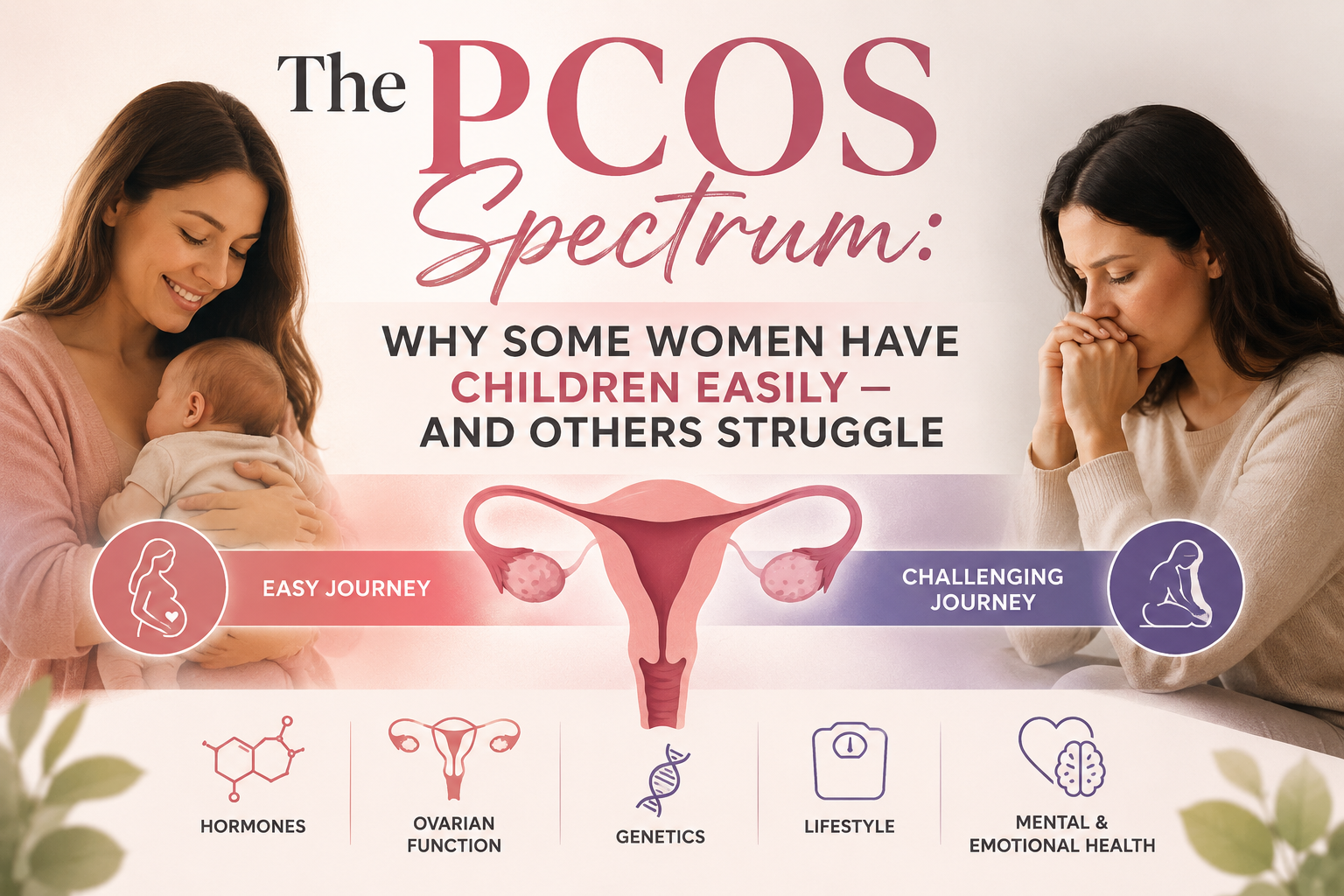
What the science actually says about polycystic ovary syndrome, fertility, and hope.
Blog article ≈ 1,900 words. Sponsored mentions shaded. This article is general information, not medical advice — please talk to your own clinician about your situation.
Two women can walk out of two different clinics on the same afternoon with the identical diagnosis — polycystic ovary syndrome, or PCOS — and go on to have completely different experiences. One conceives within the year. The other spends years navigating specialists and treatments. Same three letters, very different roads. The difference isn’t luck, and it isn’t willpower. It’s biology, and once you understand it, PCOS becomes far less frightening and far more manageable.
The name is misleading. Those ovarian “cysts” aren’t dangerous growths — they’re small, immature follicles, each holding an egg that started to develop and then stalled before release. PCOS affects roughly one in ten women of reproductive age and is the most common cause of infertility related to irregular ovulation.
Doctors diagnose it using the Rotterdam criteria: you need two of three features — irregular or absent ovulation, high androgens (“male” hormones like testosterone, which can cause acne and excess hair growth), and the polycystic appearance on ultrasound. As of the 2023 international guideline, a blood test called AMH can now stand in for the ultrasound in adults. Because you only need two of the three features, PCOS shows up in different combinations — which is exactly why no two cases look alike.
Those combinations create four “phenotypes.” Type A is the complete version — high androgens, irregular ovulation, and polycystic ovaries — and it’s usually the most metabolically serious, with the toughest fertility road. Type B pairs high androgens with irregular ovulation. Type C, often called “ovulatory PCOS,” has high androgens and polycystic ovaries but regular ovulation — so these women typically conceive more easily and have milder metabolic profiles. Type D has irregular ovulation and polycystic ovaries but normal androgens, often the gentlest picture.
The practical lesson: severity depends on whether you’re still ovulating and how out-of-balance your androgens and insulin are. The single best question to ask your doctor isn’t “do I have PCOS?” but “which type do I have, and what does that mean for me?”
If you’re wondering whether you caused this — you didn’t. Twin studies estimate PCOS is around 70% heritable, similar to height. Daughters of women with PCOS have roughly a five-fold higher risk, and male relatives show more insulin resistance and diabetes, too. Scientists have identified 20–30 risk genes so far, clustered around androgen production, insulin signaling, and follicle development — though these explain less than 10% of the inherited risk, with rarer variants and epigenetics filling in the rest. Genes load the gun; lifestyle and environment influence whether and how it fires.
Here’s the mechanism that ties PCOS together: insulin resistance. When cells stop responding well to insulin, the body pumps out more of it. That chronically high insulin does two things in the ovary — it drives up androgen production, and it disrupts the brain-to-ovary signaling that’s supposed to mature and release one egg each month. The follicles stall, ovulation stops, and you get the irregular cycles and infertility PCOS is known for. This is why metabolic health and fertility are so tightly linked in PCOS.
A word from our sponsor — Larson Nutrition
That insulin-and-androgen loop is exactly what Larson Nutrition helps women work on. Founder Kim Larson built her practice after her own metabolic wake-up call and has since helped more than three thousand clients with insulin resistance, prediabetes, metabolic syndrome, and PCOS — through personalized nutrition protocols, real biomarker monitoring, and weekly one-on-one accountability coaching. It’s nutrition and lifestyle support to complement your medical care, not replace it. Learn more at LarsonNutrition.com.
About 80% of women with PCOS are overweight, and excess weight does worsen insulin resistance. But roughly one in five has lean PCOS — a normal weight and full-blown symptoms. Insulin resistance still affects an estimated 75% of lean women with PCOS (versus about 95% of those who are overweight). The metabolic glitch is built into the condition itself, not simply a product of body size. PCOS is a metabolic and hormonal condition — not a moral failing, and not something willpower alone fixes.
It comes down to ovulation. To conceive naturally, you need to release a mature egg — and in PCOS, that’s the step that often breaks down. But here’s the reassuring twist: women with PCOS usually aren’t running out of eggs. They typically have more eggs than average (which is why AMH is high and the ovary looks full). The problem isn’t supply — it’s release. The eggs are there; the doorway is just stuck. And a stuck doorway is often something medicine can help open.
Lifestyle comes first. Because insulin sits at the center, improving metabolic health — and, for those carrying extra weight, even a 5–10% loss — can restart ovulation on its own. If medication is needed, letrozole is now the preferred first-line drug, outperforming older clomiphene (about 27% vs 19% live births in the key trial). Supporting options include metformin and inositol supplements (a myo-inositol/d-chiro-inositol blend that supports insulin signaling and cycle regularity). Newer GLP-1 medications (like semaglutide) can help with weight and metabolism in some women — but they are not fertility drugs and must be stopped before trying to conceive. Higher rungs — injectable hormones and IVF — are there if needed, and IVF works well in PCOS because there are so many eggs to work with. Most women get what they need on the lower rungs.
Most women with PCOS have children. Long-term studies show they reach family sizes close to women without PCOS — it may take longer and require some help, but the destination is often the same. Even teenagers with irregular, PCOS-type cycles overwhelmingly go on to conceive. Pregnancy does carry somewhat higher risks (gestational diabetes, high blood pressure), so it calls for attentive prenatal care — but that’s a reason for good monitoring, not fear.
PCOS is a lifelong companion that touches skin, mood, metabolism, and long-term health. Anxiety and depression are more common and deserve real support. And because chronic stress nudges the same hormones already out of balance, rest and self-care aren’t indulgences — they’re maintenance.
A word from our sponsor — Larson Botanicals
Caring for your body from the outside in matters too. Larson Botanicals makes organic-ingredient skincare and hand-crafted candles — clean, plant-powered self-care for the small daily rituals that help you feel human on the hard days. A candle won’t balance your hormones, but a few quiet minutes that belong only to you are part of living well with PCOS. Explore it at LarsonBotanicals.com.
The five things to remember: PCOS is a spectrum, not one condition; it’s largely genetic, so it isn’t your fault; insulin is the hidden engine, whether you’re lean or not; the fertility issue is usually about releasing eggs, not running out of them; and the odds are far more hopeful than the fear. The great majority of women with PCOS build the families they hope for.