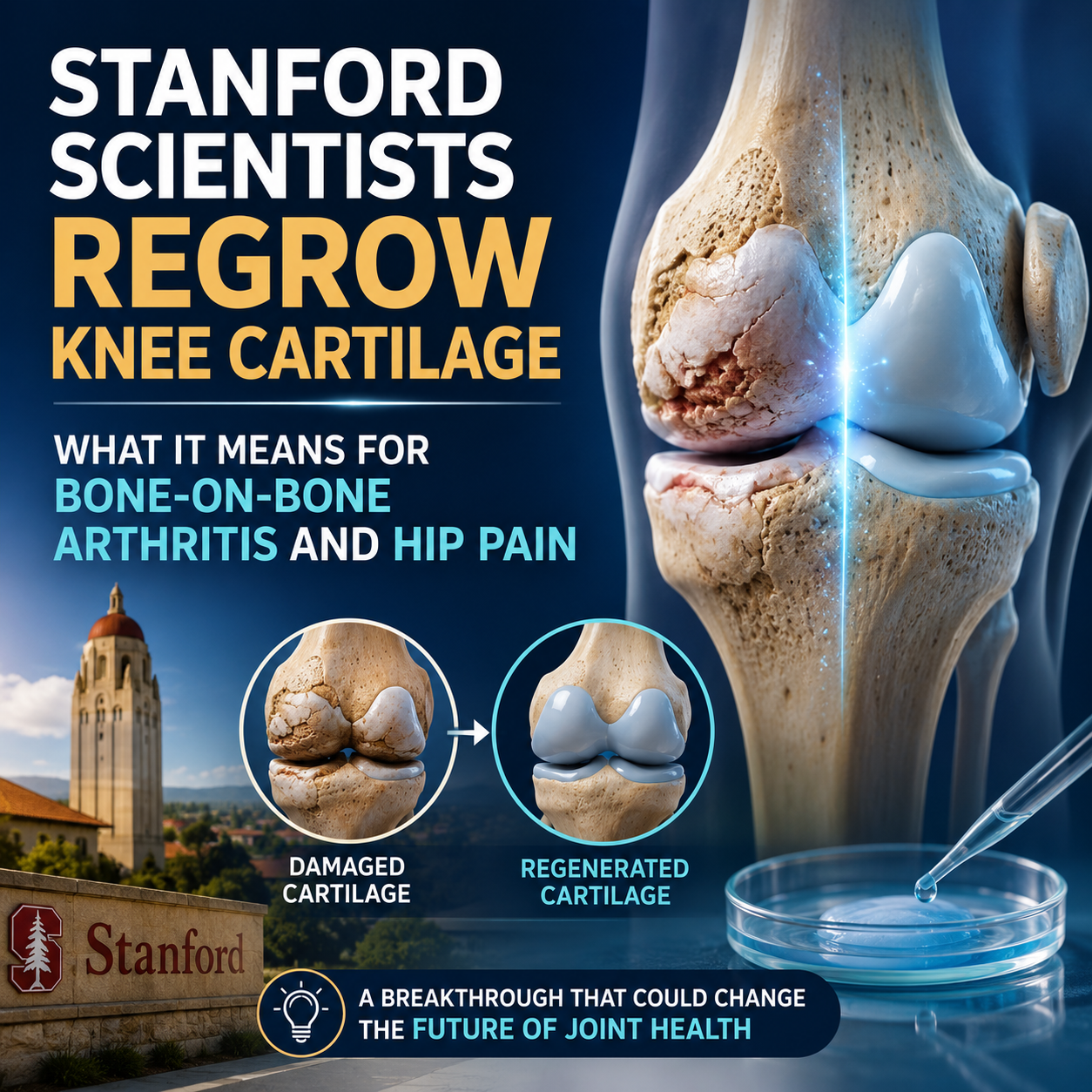
A breakdown of the science, and what it means if you’re already dealing with joint pain today.
If you’ve been living with knee or hip arthritis, you’ve probably learned to be skeptical of headlines promising a fix. So let’s talk honestly about a new study that’s actually worth your attention: Stanford researchers have found a way to regrow real, functional knee cartilage, not scar tissue, in aging mice, injured mice, and human cartilage taken from actual knee replacement surgeries.
This isn’t a wellness blog claim. It was published in Science, one of the most rigorous peer-reviewed journals in the world, led by Dr. Helen Blau, who directs Stanford’s Baxter Laboratory for Stem Cell Biology, and Dr. Nidhi Bhutani, an associate professor of orthopedic surgery. Here’s what they found, why it’s different from anything that’s come before, and what it actually means for you if you’re bone-on-bone right now.
The Discovery: Blocking One Protein Regrew Cartilage
The research centers on a protein called 15-PGDH, which naturally rises as we age. The same team had already linked this protein to age-related muscle loss in earlier work; blocking it improved muscle mass and strength in older mice, while forcing young mice to overproduce it made their muscles weaker. That raised an obvious question: does this protein play the same role in joints?
To find out, the researchers gave older mice with naturally thinning knee cartilage a small-molecule drug that blocks 15-PGDH, delivered both systemically and directly into the joint. In both cases, the thinning cartilage began to thicken again across the entire joint surface. Dr. Blau has described being genuinely surprised by how much regeneration occurred.
They also tested mice with injuries mimicking a torn ACL, the kind of trauma known to lead to arthritis later in life, even in young, otherwise healthy people. Mice that received repeated injections of the PGDH blocker after injury were significantly less likely to develop arthritis afterward. In other words, this may not just repair damage that’s already happened, it may help prevent arthritis before it starts.
Why ‘Real’ Cartilage Matters
Here’s the detail that separates this from a lot of regenerative medicine hype: the tissue that regrew was hyaline cartilage, the smooth, glassy, load-bearing cartilage your joints actually need. That’s different from fibrocartilage, the tougher, scar-tissue-like material the body often produces when patching an injury. Getting the body to regenerate true hyaline cartilage, rather than a lower-quality patch job, has been one of the hardest unsolved problems in orthopedic medicine.
And critically, this wasn’t only demonstrated in mice. The team obtained real human cartilage removed during knee replacement surgeries, from patients who were bone-on-bone, and exposed it to the same treatment. That tissue began producing new, functional cartilage. That’s the detail that moves this from an interesting mouse study to something that may genuinely be relevant to a human joint.
How This Differs from Stem Cell Therapy
Most regenerative treatments you’ve seen marketed for joints, including many stem cell clinics, rely on introducing new cells to rebuild damaged tissue. That’s not what’s happening here. Instead, the cartilage-producing cells already living in your joint, called chondrocytes, appear to reset their gene activity and start behaving like younger, tissue-building cells again, rather than the breakdown-oriented cells they become with age.
Practically, that could mean a much simpler path to treatment down the road: a local injection or, eventually, an oral medication, rather than the complicated, expensive process of harvesting and growing stem cells outside the body. A related oral drug from this same research group is already in human clinical trials for a different condition, age-related muscle weakness, and has been shown to be safe in healthy volunteers, an encouraging sign for how a cartilage-specific trial might move forward.
What This Means If You’re Bone-on-Bone Right Now
Let’s be direct: this has not yet been tested in a human clinical trial for cartilage regeneration. Dr. Blau has said her hope is that a similar trial will be launched to test the drug’s effect on cartilage specifically, but that process, typically moving through Phase 1 safety trials, then larger effectiveness trials, usually takes years, not months.
If you’re bone-on-bone today and your surgeon has recommended a replacement, this research isn’t a reason to delay necessary care. Joint replacement is a well-established, high-success-rate procedure. But if you’re earlier in the process, with moderate arthritis but no replacement recommended yet, this is exactly the kind of finding that makes protecting the cartilage you still have more worthwhile than ever: managing weight, building strength around the joint, and reducing systemic inflammation through diet and lifestyle.
It’s also worth noting this applies beyond the knee. Hip cartilage is the same type of tissue, made by the same chondrocytes, and the Stanford team’s models weren’t limited to knee joints alone. There’s no clear biological reason a therapy that works on knee cartilage wouldn’t eventually apply to hips as well.
The Bottom Line
This is genuinely one of the more promising developments in osteoarthritis research in years, backed by rigorous, peer-reviewed science and real human tissue data, not just a mouse study. It’s not available as a treatment yet, and it’s worth being skeptical of any clinic that claims otherwise before an approved therapy exists. But it points toward a future where osteoarthritis could become a disease we actually treat at the source, rather than one we simply manage until a joint replacement becomes necessary.
In the meantime, the fundamentals still matter: keep the joint moving, build the muscles that support it, manage inflammation, and stay in touch with your doctor about how this research develops. We’ll be watching closely, and we’ll keep you updated as it moves toward human trials.