A closer look at what raising NAD+ really does inside a body that may already have cancer in it — and why the answer depends entirely on who’s asking.
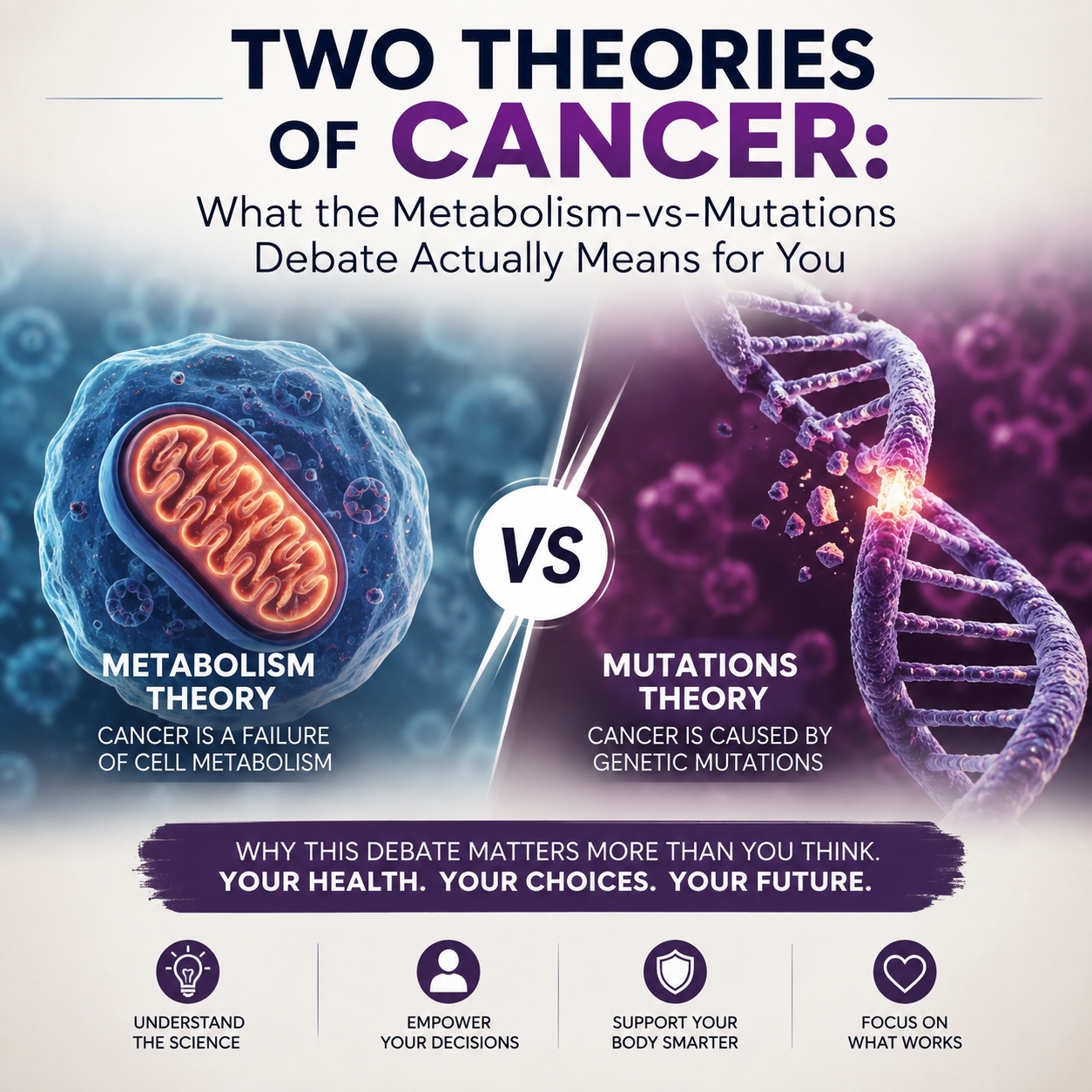
NAD+ sits at the center of two research programs that want opposite things. Longevity labs want to raise it. Oncology labs have spent two decades trying to drain it out of tumors. Both camps have good reasons, and that tension is exactly why the cancer question resists a clean answer.
The starting fact is uncomfortable: every cell you have runs on NAD+, and so does every cancer cell. NAD+ is the cofactor behind the redox reactions of glycolysis, oxidative phosphorylation, fatty acid oxidation, and the TCA cycle. It also fuels two enzyme families cancer leans on heavily — PARPs, which repair DNA damage, and sirtuins, which manage cellular stress and gene expression. Because tumors reprogram their metabolism and divide fast, they burn through NAD+ and have to keep remaking it, mostly through a single salvage enzyme called NAMPT, which is overexpressed across a long list of cancers.
So there are two ways to point NAD+ at cancer, and researchers have chased both.
If tumors depend on NAD+, the logic goes, starve them of it. That thinking drove a generation of NAMPT inhibitors. FK866 and CHS828 killed cancer cells at nanomolar concentrations in the lab and shrank tumors in mice. The problem showed up once these drugs reached people.
At the doses needed to work, the earliest versions caused serious side effects — dangerously low platelet counts (the blood cells that help you stop bleeding) and significant digestive problems. On top of that, the drugs rarely shrank tumors in a measurable way. Together, those two problems were enough to shut down most of the early drug programs, a story documented in a 2022 review by Navas and Carnero.
Newer compounds are trying to widen that therapeutic window. KPT-9274, a dual PAK4-NAMPT inhibitor, has moved through first-in-human testing in advanced solid tumors, sometimes paired with niacin to spare healthy tissue. The depletion strategy isn’t dead — but after twenty years, no NAD-lowering drug has become standard care. That tells you how narrow the margin is between hurting the tumor and hurting the patient.
The other direction is where supplements live, and here the flagship evidence is genuinely positive. Nicotinamide, a form of vitamin B3, is a direct precursor to NAD+. Taken as a supplement, it feeds through the same salvage pathway cancer cells depend on, converting into NAD+ via NAMPT. The idea: if depleting NAD+ can kill a tumor, topping it up might help healthy cells protect themselves.
The standout study is a trial called ONTRAC. In 2015, Chen and colleagues randomly split 386 people with healthy immune systems but a history of skin cancer (each had had at least two non-melanoma skin cancers in the previous five years) into two groups. One group took nicotinamide at 500 mg twice a day for a year; the other took a placebo. Randomizing people and comparing against a placebo is the gold standard for figuring out whether a treatment actually works.
The result: the vitamin group developed 23% fewer new skin cancers than the placebo group. There’s a sensible mechanism behind it, too — nicotinamide helps skin cells repair UV-induced DNA damage and counteracts the way sun exposure weakens the skin’s local immune defenses.
In 2023, Allen and colleagues repeated essentially the same experiment in a much higher-risk group: 158 organ-transplant recipients, who take immune-suppressing drugs that leave them far more prone to skin cancer. Same vitamin, same dose, same length of time. This time, the benefit disappeared. New skin cancers came in at almost exactly the same rate in both groups — 207 cases in the vitamin group versus 210 in the placebo group.
There’s some debate about why. Critics point out that the second trial was stopped early and didn’t enroll enough people to reliably detect a benefit, so a real effect could have been missed. Either way, the takeaway holds: a result that looked solid in one group of people didn’t automatically carry over to another.
The NAD+ supplements most people actually take are precursors — raw materials the body uses to build NAD+. The two common ones are nicotinamide riboside (NR) and nicotinamide mononucleotide (NMN). The early cancer research on these openly contradicts itself.
In 2022, Maric and colleagues tagged NR with a glowing chemical marker to track where it went inside living tissue. Aggressive triple-negative breast cancer cells soaked up about four times more of the tag than milder cancer cells did. In mice with weakened immune systems, a diet rich in NR caused that breast cancer to spread to the brain more.
A year later, Jiang and colleagues reported the opposite in the same cancer type. Using mice carrying tumors grown from actual human patient samples, they found that boosting NAD+ with NMN reduced the cancer’s spread and helped the mice live about 15% longer. When they disabled a specific signaling pathway involving the protein SIRT1, the benefit vanished — evidence that this pathway was responsible for the good effect.
Same aggressive cancer. Opposite conclusions. Both in mice, using different methods and setups, and neither telling us what would happen in a human body. The honest reading is that these supplements don’t behave in a simply “protective” or “harmful” way — their effects depend heavily on context.
The newest study adds weight to that caution. In 2026, Nakazzi and colleagues tested three NAD+ precursors in pancreatic cancer, one of the deadliest cancers there is. Across both lab dishes and mice, the precursors — with NMN having the strongest effect — shielded cancer cells from three standard chemotherapy drugs.
The mechanism was clear, and not welcome news: the supplements strengthened the cancer cells’ internal energy machinery and reduced their stress levels, helping them survive the very damage chemotherapy is designed to inflict. In a disease where only about 13% of patients are alive five years after diagnosis, anything that weakens chemotherapy is a serious concern.
Set against those alarming animal results, the human data is reassuring, if thin. No clinical study has shown that NAD+ precursors cause cancer in people. More than seventy human trials indicate that NR and NMN reliably raise NAD+ and are generally well tolerated over weeks to months, with side effects that tend toward mild — nausea, digestive upset, headache, flushing, cramps. Decades of experience with niacin and nicotinamide add to that safety record.
The limits are worth naming plainly: trials have been short, so nothing tells us what years of daily use does. And nearly all the worrying signals come from animals with active, aggressive tumors already growing — not from healthy people taking a daily capsule.
The answer gets clearer once you sort people by one question: is a tumor already in the picture?
The read here is “well tolerated, benefit unproven.” NR and NMN raise NAD+ reliably with mostly mild side effects over the weeks-to-months windows trials have tested. What no study can promise this group is long-term safety, since those trials haven’t been run, or long-term payoff, since the strongest lifespan test in mice came up empty. The tradeoff is low apparent short-term risk against an unproven reward.
Here the caution is real and specific. Every worrying result — the pancreatic chemoresistance finding and the breast-cancer metastasis signal alike — comes from models with a tumor already growing. The concern isn’t that a precursor plants cancer in a healthy body. It’s that it may feed cells that are already malignant, and may blunt chemotherapy that depends on oxidative stress and DNA damage to work. The pancreatic-cancer authors went as far as calling for routine supplement screening in patients.
Anyone in active treatment, or with a personal or strong family history of cancer, has reason to hold off until an oncology team weighs in.
Where the evidence lands: NAD+ precursors look safe enough for healthy, short-term use, and carry genuinely unknown long-term risk. The clearest reason to avoid them right now is active cancer or high cancer risk. The single fact that decides which group you’re in is whether a tumor is already in the room.
Want to build the metabolic foundation that supports healthy cellular energy — food first, supplements second, and always with the full picture in view? That’s the work we do together at Larson Nutrition.
This article discusses cancer risk and supplement safety and is for general information, not medical advice. Anyone with a cancer history, active cancer, or ongoing treatment should talk with their oncology team before using NAD+ precursors.