Cancer research has quietly split into two camps for decades. One says it starts with a broken gene. The other says it starts with broken cellular energy. Here’s what each side actually claims, and where the honest evidence lands.
Here’s a question that sounds simple but isn’t: what actually causes cancer?
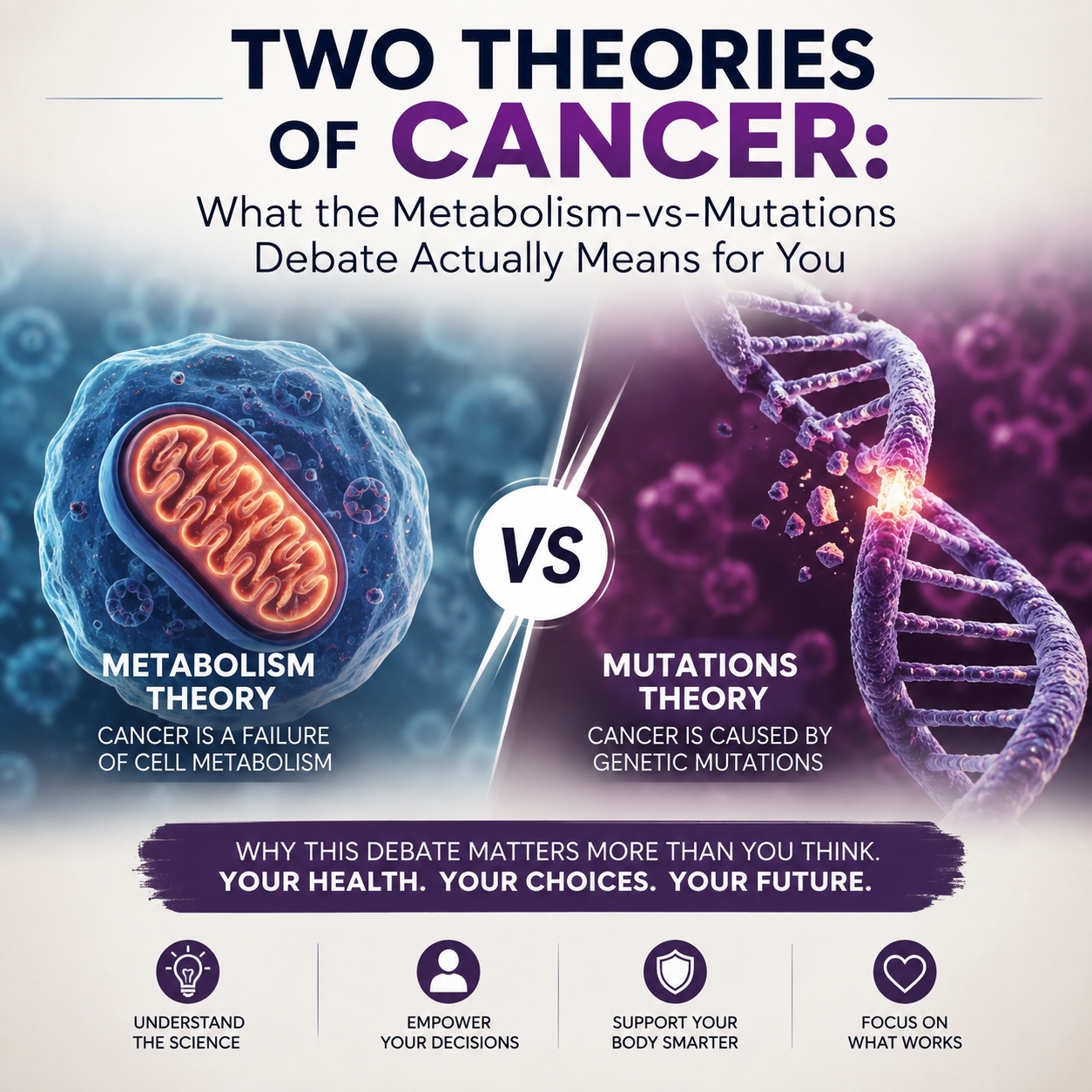
For the last seventy years, the answer from most oncologists, textbooks, and pharmaceutical companies has been the same. Cancer is a genetic disease. Something goes wrong in your DNA — a mutation, or a series of them — and a cell stops listening to the rules that normally keep growth in check. It grows when it shouldn’t. It spreads when it shouldn’t. Nearly the entire architecture of modern cancer treatment — chemotherapy, targeted therapy, much of immunotherapy — is built around that idea: find the mutation, hit the mutation.
But there’s a second explanation, actually older than the mutation theory, and it’s having a real resurgence right now. It argues that cancer isn’t primarily a disease of your genes at all — it’s a disease of your metabolism, specifically of the mitochondria, the tiny power plants inside every one of your cells. If that theory is even partly right, it opens up different questions about prevention and about what role metabolic health might play alongside — not instead of — standard treatment.
This is one of the more genuinely interesting disagreements happening in cancer science right now. It’s not settled, and it’s not simple. So let’s walk through where each theory came from, what the evidence shows, and where the honest, responsible middle ground actually sits.
The somatic mutation theory has been the dominant paradigm in oncology since the 1970s. The core idea: cancer begins when DNA damage accumulates in a cell’s nucleus — from radiation, chemicals, viruses, or random replication errors — until a critical mutation disables the genes that normally control cell division or repair DNA damage. Once that happens, the cell divides uncontrollably, and further mutations accumulate as the tumor grows and spreads.
This framework has driven enormous progress. It’s the reason we can now sequence a tumor’s DNA and match patients to targeted drugs built for their specific mutation. Immunotherapy, which trains the immune system to recognize mutation-driven abnormalities on cancer cells, has extended survival in cancers that were once nearly always fatal. The genetic model isn’t wrong — mutations are real, they matter, and treatments built around them save lives every day.
Nearly a century ago, German biochemist Otto Warburg observed something strange: cancer cells generate energy differently than healthy cells do. Even with plenty of oxygen available, tumor cells rely heavily on fermentation — a less efficient energy pathway normally used only when oxygen is scarce. This came to be known as the Warburg effect, and it’s still observable in the vast majority of solid tumors today, which is exactly why PET scans (which track glucose uptake) can find cancer in the first place.
For decades, mainstream oncology treated the Warburg effect as a downstream symptom of cancer — a byproduct of mutated genes reprogramming metabolism, not a cause. Boston College biologist Thomas Seyfried has spent over three decades making the opposite case. His argument, laid out across more than 150 peer-reviewed papers and his book Cancer as a Metabolic Disease, is that damaged mitochondria come first: when a cell’s mitochondria can no longer perform normal respiration, the cell shifts to fermentation to survive, and the nuclear mutations researchers find in tumors are a downstream consequence of that dysfunction rather than the root cause.
It’s important to be direct about where this stands scientifically: Seyfried’s metabolic theory is a real, published, peer-reviewed line of research — but it remains a minority position, not the scientific consensus. Most oncologists and cancer biologists still regard genetic mutation as the primary driver, with metabolic reprogramming as an important secondary feature. The debate between the two camps is genuine and unresolved, not a case of fringe science versus real science.
Building on the metabolic theory, Seyfried and colleagues developed what they call “press-pulse” therapy. The concept borrows from ecology: populations decline fastest when a chronic stress (the “press”) coincides with an acute stress (the “pulse”). Applied to cancer, the “press” is typically a calorie-restricted ketogenic diet, which lowers blood glucose and limits the fermentable fuel tumor cells depend on, while healthy cells adapt to running on ketones instead. The “pulse” is an added acute intervention — which might be a glutamine-blocking drug, hyperbaric oxygen, or, in most protocols actually used in practice, conventional chemotherapy or radiation layered on top of the metabolic stress rather than replacing it.
This isn’t purely theoretical. Preclinical work in aggressive brain tumor models has shown stronger tumor control when a calorie-restricted ketogenic diet is combined with metabolism-targeting drugs than either approach alone. Human research is further behind but growing: small trials and case series have tested ketogenic diets as an add-on to standard treatment in glioblastoma, one of the most aggressive brain cancers, with some encouraging signals on tolerability and quality of life. A handful of trials have also looked at ketogenic diets in metastatic breast cancer.
What’s critical to understand is the word add-on. Even Seyfried’s own writing on press-pulse therapy is explicit that practitioners must continue conventional treatments like chemotherapy and radiation alongside the metabolic protocol — not instead of them. Clinics and researchers actively working in this space describe metabolic and repurposed-drug approaches as adjunctive, not as a replacement for oncologic care.
This is also where a genuinely interesting research frontier gets distorted online. A few claims circulate that go well beyond what the evidence supports, and they’re worth naming directly:
For someone in active treatment, or with a new diagnosis, hearing an oversimplified version of this science — “just cut sugar and starve it” — can be genuinely dangerous if it leads to delaying or declining proven treatment, or to unsupervised, aggressive calorie restriction during a period when the body needs nutritional reserve to tolerate chemotherapy or heal from surgery.
Both camps in this debate are working with real data, and the truth likely isn’t fully captured by either extreme. Mutations clearly matter enormously — that’s not in dispute. Metabolism also clearly matters, in ways oncology is only recently starting to take seriously in mainstream research funding and clinical trials. The most credible reading of where the science stands today: cancer likely involves both genetic damage and metabolic dysfunction, feeding into each other, and untangling cause from effect may not even be the most useful question.
What that means practically: metabolic health — what you eat, your blood sugar control, your inflammation levels — is a legitimate, active area of cancer research, worth paying attention to as prevention and worth discussing with an oncology team as a possible adjunct during treatment. It is not, based on current evidence, a substitute for the surgery, chemotherapy, radiation, or targeted therapy that actual clinical trials have shown extends survival.
If you or someone you love is navigating an active cancer diagnosis and wants to explore metabolic approaches like a ketogenic diet, the responsible path is doing it with an oncology team involved — not as a replacement for their guidance, but as one more tool discussed openly with the people managing your care.
Where the evidence lands: the metabolic theory of cancer is real science worth following, not a fringe idea and not a cure. The mutation theory built the treatments that are saving lives today. The most honest position is holding both — taking metabolic health seriously as prevention and as a supportive strategy, while trusting proven oncologic treatment to do the heavy lifting once cancer is already present.
Curious how to build real metabolic resilience through food, before disease is ever in the picture? That foundational work — blood sugar balance, reducing inflammation, and building a body that’s harder for chronic disease to take hold in — is exactly what we focus on at Larson Nutrition.
This article is for general education and discusses an active, unsettled area of cancer research. It is not medical advice and should not be used to guide treatment decisions. Anyone with an active cancer diagnosis or cancer history should talk with their oncology team before making any changes to diet, supplements, or treatment.